
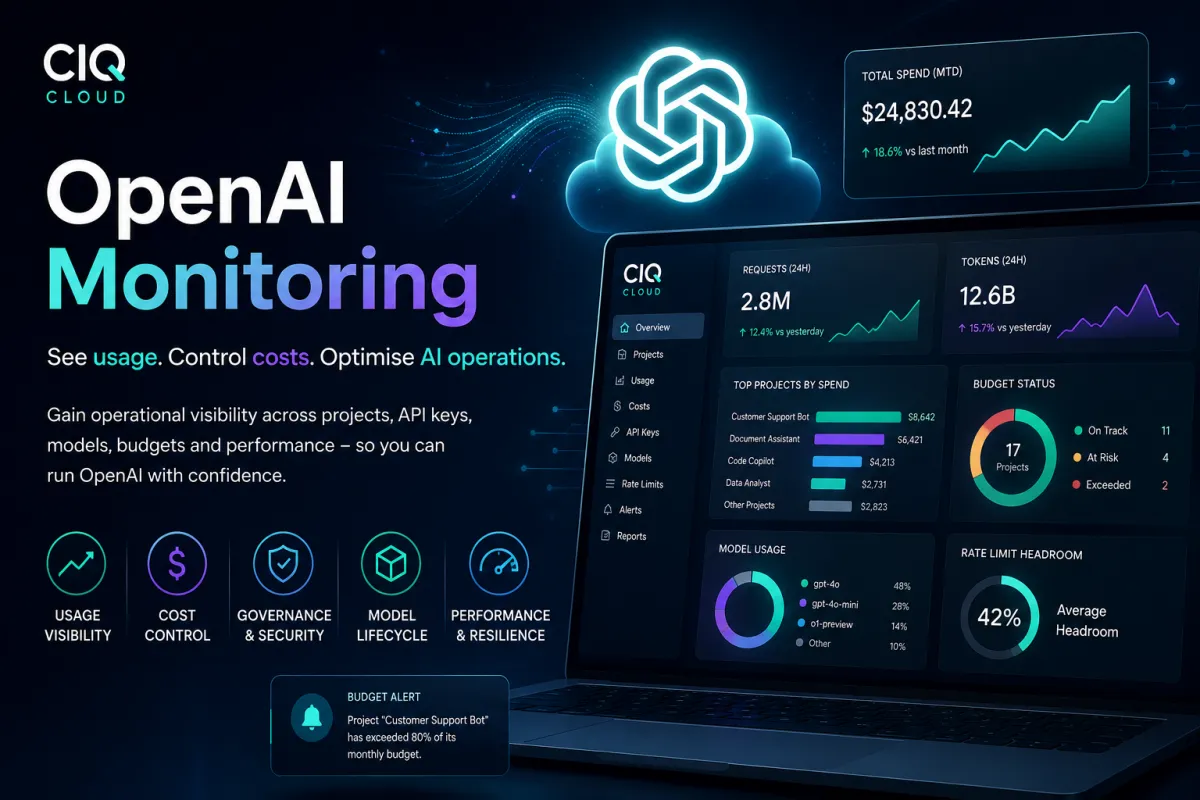
OpenAI Monitoring - what you need to know
OpenAI Monitoring: Why Every Organisation Should Monitor AI Usage, Costs and Performance
OpenAI Monitoring - what you need to know
Artificial Intelligence has moved beyond experimentation.
Across businesses of every size, OpenAI models are now powering customer service assistants, internal knowledge bases, document analysis, software development, workflow automation and intelligent business applications. What often begins as a single proof of concept quickly evolves into multiple projects supporting critical business processes.
While organisations invest significant time choosing the right models and developing effective prompts, many overlook an equally important question:
How do you operate OpenAI once it reaches production?
For many organisations, OpenAI is another business-critical cloud service alongside Microsoft 365, Google Workspace, AWS and Azure. Yet unlike these mature platforms, AI introduces an entirely new operational challenge. Costs can increase overnight, new models are released frequently, API keys multiply across projects, and rate limits can affect application performance without warning.
This is where OpenAI Monitoring becomes essential.
Effective monitoring is no longer simply about collecting API statistics. It provides IT teams with the operational visibility needed to understand how AI is being used, control costs, improve governance and ensure applications continue running reliably as adoption grows.
The New Operational Challenge
Most organisations begin their AI journey in a familiar way.
A developer creates a project, generates an API key and builds a proof of concept using the latest OpenAI model. Everything works well, the project demonstrates value, and before long another department wants to build their own AI-powered solution.
Six months later, the organisation may have:
Multiple OpenAI projects
Development, testing and production environments
Several API keys
Different language models
Multiple application owners
Increasing monthly costs
Growing numbers of AI-powered business applications
At this point, operational questions begin to replace development questions.
Instead of asking:
"Can we build this with AI?"
IT Operations teams start asking:
Which projects are generating the highest costs?
Which API keys are still being used?
Which applications are using outdated models?
Are any projects approaching their monthly budget?
How close are we to our rate limits?
Which projects need attention today?
Unfortunately, these questions are often difficult to answer using invoices or individual project dashboards alone.
Without centralised AI monitoring, organisations can quickly lose visibility over their AI estate, increasing operational risk and making it harder to optimise both performance and costs.
OpenAI Monitoring Without Changing Your Applications
One of the biggest misconceptions surrounding OpenAI monitoring is that every application must be modified to collect operational data.
While application instrumentation certainly has its place for developer observability and prompt analysis, much of the information required by IT Operations teams is already available through the OpenAI management platform.
This means organisations can gain valuable operational insight without deploying additional agents or making changes to existing applications.
By securely collecting management and operational information, it becomes possible to monitor:
Overall usage across your organisation
Usage by Project
API key activity
Daily and monthly costs
Project budgets
Model usage
Rate limits and remaining capacity
API key lifecycle
New model releases
Model deprecation and retirement dates
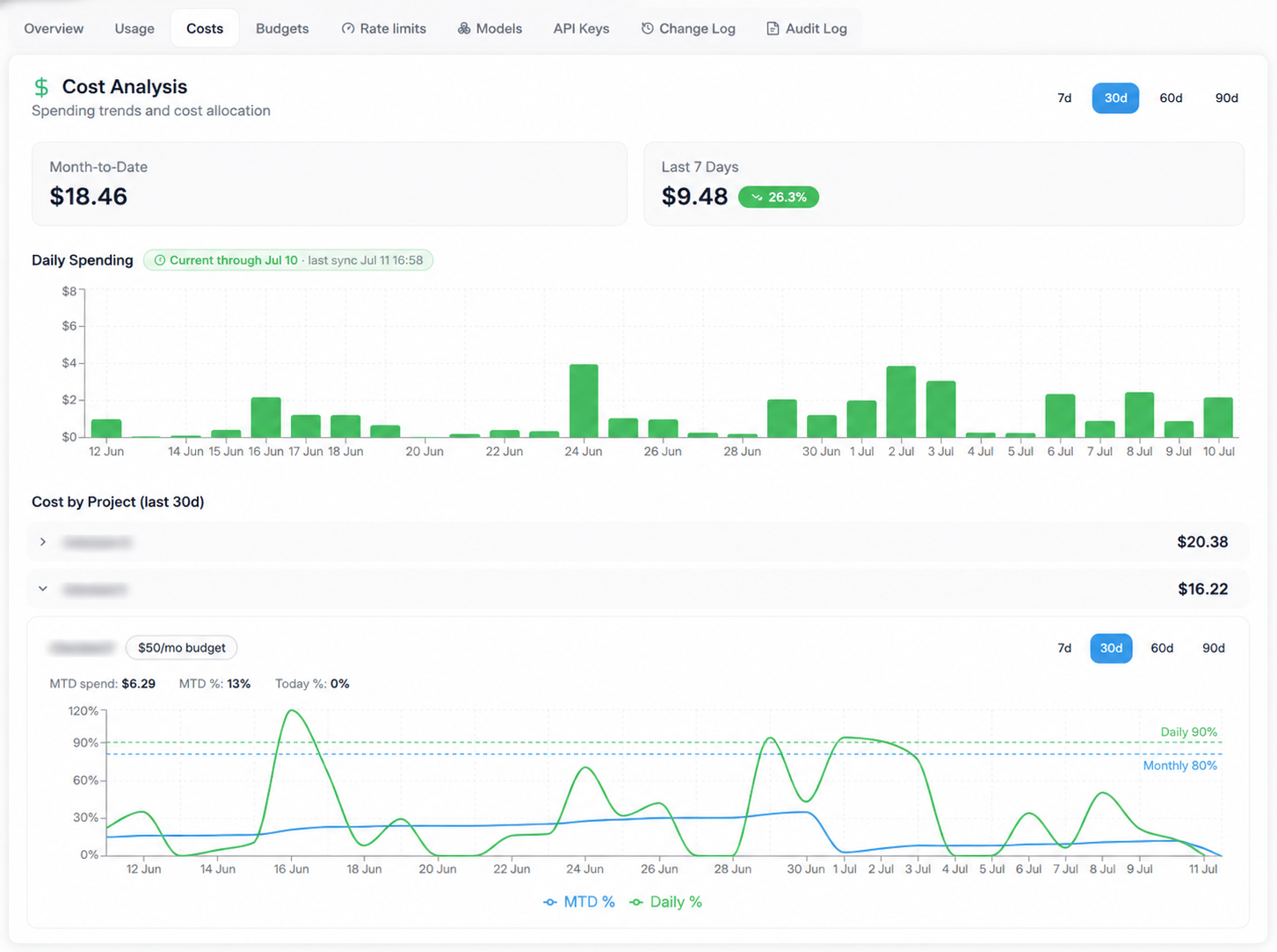
Rather than requiring every development team to implement additional monitoring, IT administrators gain a central operational view of their OpenAI environment, helping them identify issues before they affect users or budgets.
Why OpenAI Monitoring Matters
Unlike traditional cloud infrastructure, AI introduces a unique combination of technical, operational and financial considerations.
A single application update can dramatically increase token consumption. A forgotten development project may continue generating costs long after it has been abandoned. An older model might remain in production despite newer alternatives offering better performance at lower cost.
Without visibility, these issues often remain unnoticed until the monthly invoice arrives or an application experiences unexpected failures.
OpenAI monitoring enables organisations to move from reactive troubleshooting to proactive management.
Instead of asking why costs increased last month, administrators can identify unusual spending patterns as they happen. Instead of discovering that a model has reached end-of-life after it stops working, teams can plan migrations months in advance. Instead of waiting for users to report slow AI responses, operations teams can identify capacity constraints before they become service issues.
Monitoring therefore becomes much more than reporting. It becomes an essential part of operating AI services at scale.
What Should You Monitor?
Every organisation will have slightly different priorities depending on how AI is being used, but there are several operational areas that should form the foundation of every OpenAI monitoring strategy.
Monitor Usage Across Your Organisation
Understanding how OpenAI is being used is the first step towards effective AI governance.
Many organisations are surprised to discover how quickly AI adoption grows once the first successful projects are deployed. New applications appear across different departments, development teams create additional projects for testing, and multiple API keys are generated to support different environments.
Without a central view, it becomes difficult to understand where AI is delivering value and where resources may be being consumed unnecessarily.
Usage monitoring should provide visibility into overall activity across the organisation, allowing administrators to understand which projects are active, how usage is changing over time and where demand is increasing.
Rather than simply reporting the total number of requests, effective monitoring should help answer business questions such as:
Which projects are driving adoption?
Which applications generate the most activity?
Are there projects that are no longer being used?
How is AI usage changing month by month?
Which environments require further investigation?
By understanding usage trends, organisations can make better decisions around capacity planning, budgeting and future AI investment.
Keep OpenAI Costs Under Control
For many organisations, the monthly OpenAI invoice is the first indication that AI adoption has accelerated.
Unlike traditional software licensing, AI costs are consumption-based. As new projects are deployed, more users adopt AI-powered applications or prompts become more sophisticated, costs can increase rapidly without any changes to your infrastructure.
This makes continuous cost monitoring an essential part of operating OpenAI in production.
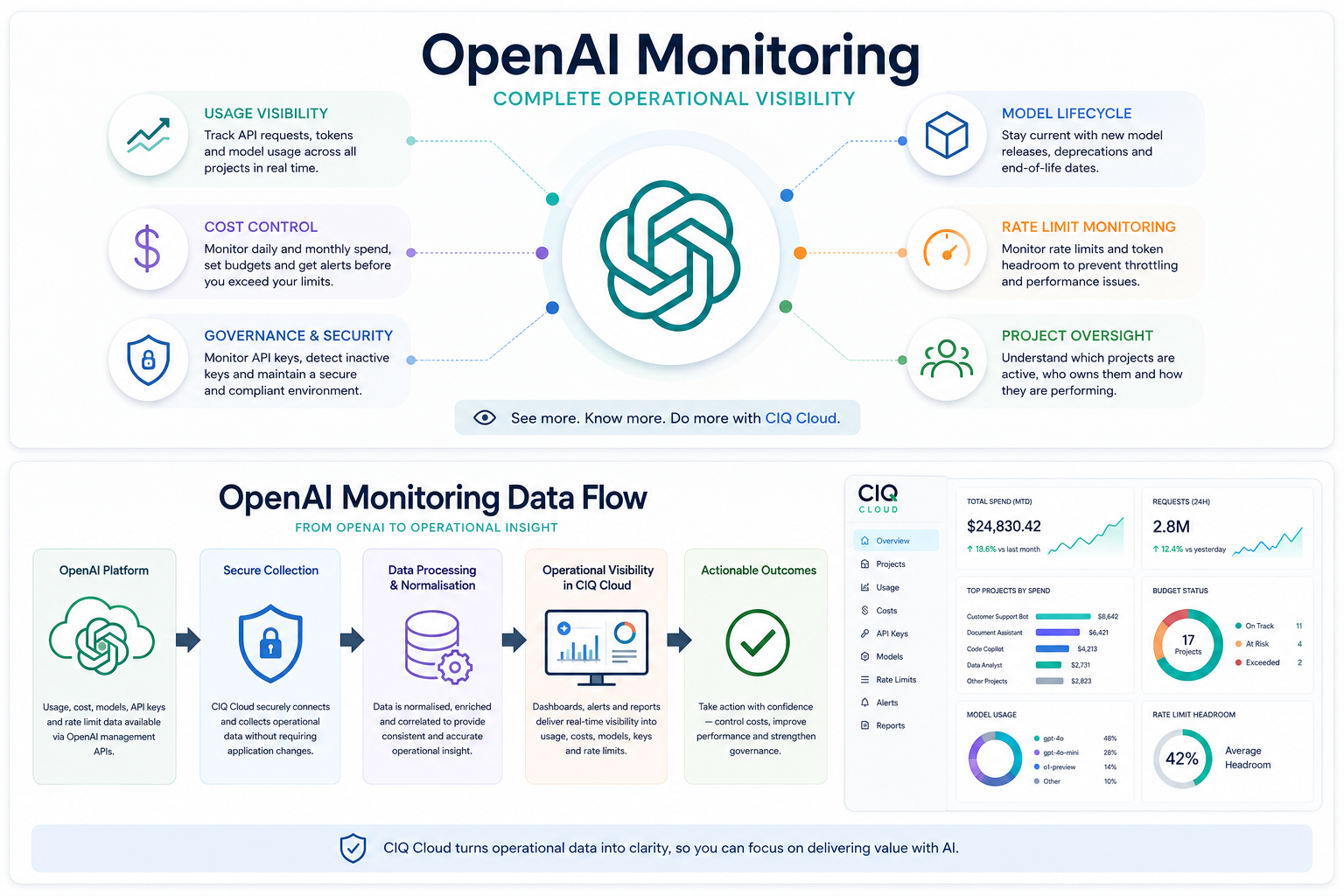
Rather than waiting for month-end billing reports, IT teams should have visibility into spending as it happens. Understanding daily consumption trends allows administrators to identify unusual activity early, investigate unexpected increases and make informed decisions before budgets are exceeded.
Effective OpenAI monitoring should answer questions such as:
Which projects are generating the highest costs?
Which applications have seen a sudden increase in spending?
How much has been spent today compared to normal?
Which models contribute most to monthly costs?
Are we likely to exceed this month's budget?
Project-level budgeting is particularly valuable for organisations running multiple AI initiatives. Development, testing and production environments can all be monitored independently, allowing costs to be allocated to individual departments, customers or business units.
By monitoring daily and monthly budgets, organisations can receive alerts before spending exceeds agreed thresholds, transforming AI cost management from a reactive exercise into a proactive operational process.
Stay Current with the Latest AI Models
Technology evolves quickly, and AI evolves even faster.
OpenAI regularly introduces new models that offer improvements in reasoning, speed, context windows, multimodal capabilities and cost efficiency. At the same time, older models eventually enter deprecation before reaching their published end-of-life dates.
Unfortunately, production applications often continue using older models simply because "they still work."
This creates what could be described as AI Technical Debt.
Just as organisations accumulate technical debt by running unsupported operating systems or outdated software libraries, AI applications can accumulate technical debt when they continue using language models that are no longer recommended or are approaching retirement.
Without visibility, administrators may not realise that a business-critical application is relying on a model that will soon be deprecated.
Monitoring model lifecycle helps organisations answer important operational questions:
Which models are currently being used?
Are newer models available?
Which projects are using deprecated models?
Which models are approaching end-of-life?
Which applications should be prioritised for migration?
Where could newer models reduce costs or improve performance?
CIQ Cloud extends operational visibility by tracking the models used across every monitored project and comparing them with the latest available OpenAI releases. It also monitors published deprecation announcements and end-of-life schedules, helping organisations plan migrations well before support ends.
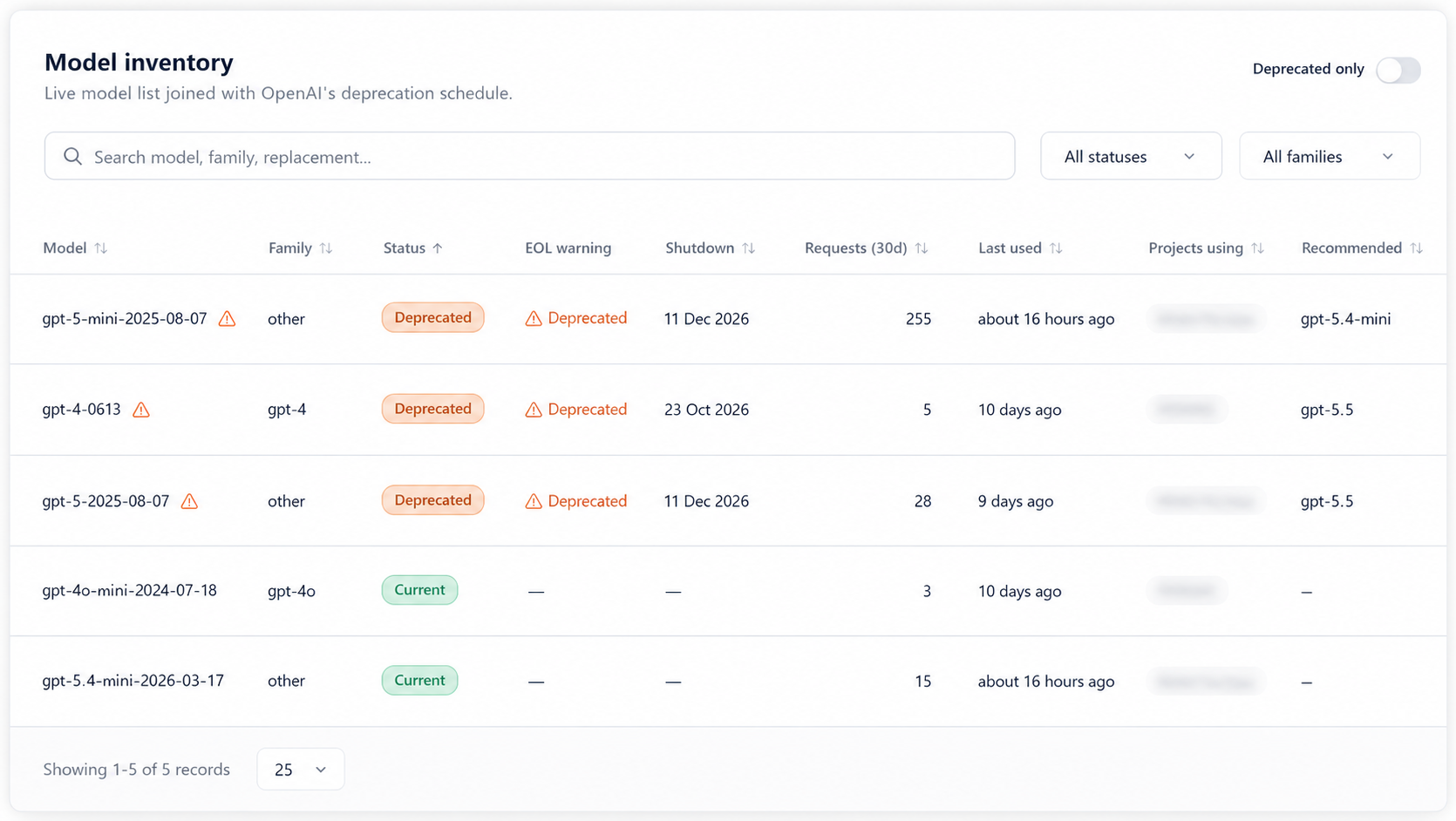
Rather than discovering a retirement notice during routine maintenance, administrators gain advance warning, allowing upgrades to be scheduled alongside normal development cycles.
Monitor API Keys and Operational Governance
API keys are the foundation of every OpenAI deployment.
Over time, however, organisations naturally accumulate multiple keys for development, production, automation, testing and integration projects. As teams grow and projects evolve, it becomes increasingly difficult to understand which keys are still required and who owns them.
Unused or forgotten API keys represent both an operational and security concern.
Good governance begins with visibility.
Administrators should be able to identify:
Active API keys
Inactive API keys
Newly created keys
Keys with no recent activity
Projects with multiple unused credentials
Projects that may no longer have an owner
Inactive API keys are particularly important. While they may no longer be generating requests, they still represent credentials that could potentially be misused if they remain active unnecessarily.
Monitoring key activity enables organisations to regularly review credentials, remove obsolete keys and maintain a cleaner, more secure OpenAI environment.
Operational governance also extends beyond API keys. Monitoring project ownership, budgets and approved models helps ensure AI services remain aligned with organisational standards as adoption continues to grow.
Monitor Rate Limits Before They Become Problems
Performance issues are often noticed by users long before they appear in support tickets.
As AI adoption grows, organisations can gradually approach their allocated rate limits without realising it. Eventually, applications may begin experiencing throttling, retries or slower responses during busy periods.
Waiting until rate limits are reached is already too late.
Instead, IT teams should monitor remaining operational headroom, allowing them to understand how close each project is to its configured limits.
Monitoring should include:
Current rate limit utilisation
Remaining request capacity
Available token headroom
Projects approaching operational limits
Usage trends over time
This provides valuable early warning that capacity planning may be required.
Rather than reacting to service degradation after users begin reporting issues, administrators can identify increasing demand and plan accordingly.
For organisations running customer-facing AI applications, this proactive approach helps maintain a more consistent user experience while reducing the risk of unexpected interruptions.
Bringing Operational Visibility to OpenAI
Many monitoring solutions focus on individual metrics.
Operational Visibility is different.
Rather than asking administrators to analyse dozens of dashboards, charts and reports, operational visibility brings together the information that matters most, highlighting where action is required today.
Instead of simply reporting API usage, it helps answer operational questions such as:
Which projects exceeded today's budget?
Which applications require model upgrades?
Which API keys should be retired?
Which projects are approaching rate limits?
Where is AI adoption increasing fastest?
Which environments require immediate attention?
This allows IT Operations teams to spend less time searching for information and more time improving the services they deliver.
As organisations increasingly rely on AI, operational visibility becomes just as important as visibility into Microsoft 365, cloud infrastructure or network services.
How CIQ Cloud Helps
CIQ® Cloud provides a central operational view of your OpenAI environment, helping organisations understand usage, control costs and maintain governance without requiring changes to existing applications.
Using the operational information already available through the OpenAI platform, CIQ Cloud continuously monitors your OpenAI estate, presenting actionable insights through intuitive dashboards, trend reporting and proactive alerting.
Key capabilities include:
Organisation-wide usage summaries
Project-level usage analytics
Daily and monthly cost monitoring
Budget monitoring and threshold alerts
Model usage and lifecycle monitoring
New model release notifications
Deprecation and end-of-life awareness
API key activity and inactive key reporting
Rate limit monitoring and remaining headroom
Operational dashboards for IT teams and MSPs
Rather than managing multiple projects individually, administrators gain a single view of their OpenAI environment, making it easier to identify opportunities for optimisation while reducing operational risk.
Whether you are running one AI-powered application or managing OpenAI across multiple customers and business units, CIQ Cloud helps transform monitoring data into meaningful operational insight.
Conclusion
Artificial Intelligence is now just another critical business service.
As organisations deploy more AI-powered applications, operational complexity inevitably increases. Projects multiply, API keys accumulate, new models are released, costs fluctuate and governance becomes more challenging.
OpenAI monitoring is no longer simply about measuring API activity.
It is about giving IT teams the visibility they need to operate AI with confidence. However OpenAI isn't the only AI solution used by businesses and employees, you need to understand which other AI tools are being used within your business. AI Estate Discovery is a integral part of the CIQ Cloud Artificial Intelligence service designed to help MPS's and customers understand how AI is being used in within the business.
By monitoring usage, controlling costs, managing model lifecycles, strengthening governance and maintaining operational resilience, organisations can ensure their AI investments remain secure, cost-effective and ready to scale.
At CIQ Cloud, we believe this broader approach is Operational Visibility—providing the insight needed not only to understand what has happened, but to identify what requires attention next.
As AI continues to become part of everyday business operations, organisations that invest in operational visibility today will be better positioned to manage tomorrow's opportunities with confidence.
Try CIQ Cloud today to gain Operational Visibility into OpenAI usage within your business.