
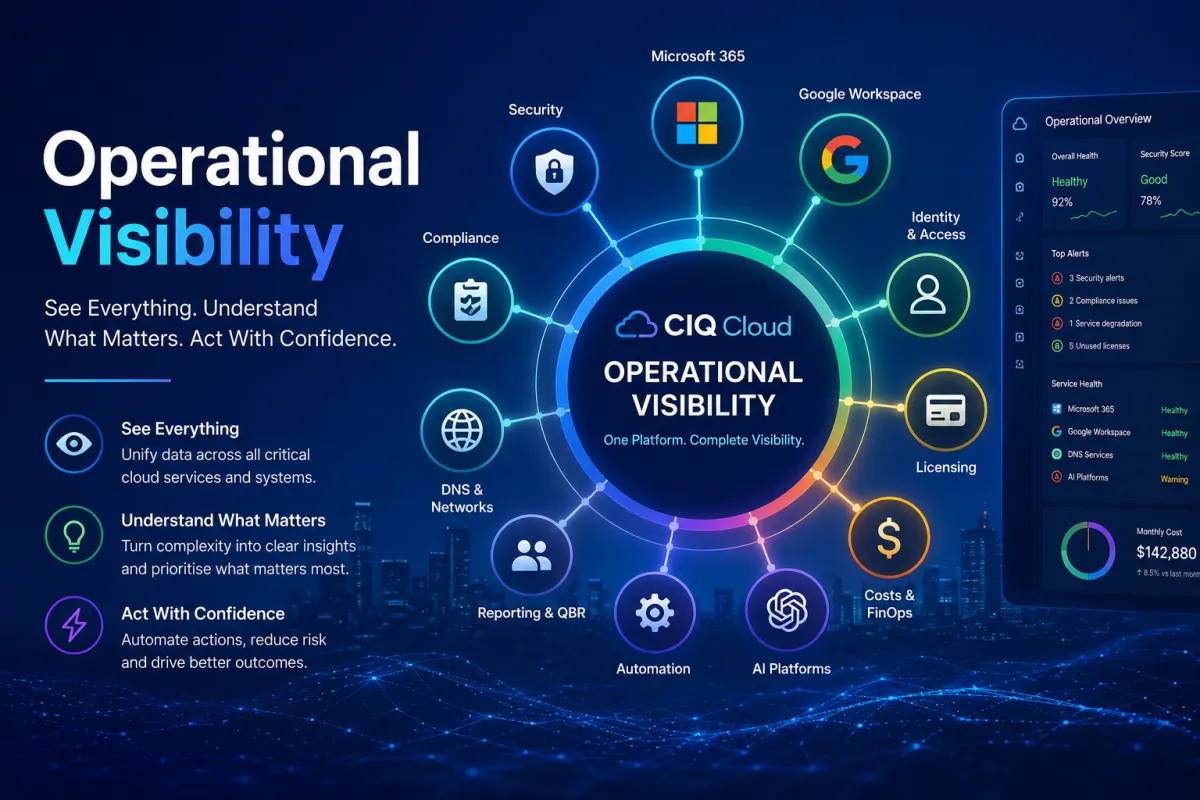
Operational Visibility: See Everything. Understand What Matters. Act With Confidence.
Modern IT environments have become increasingly complex.
Organisations now depend on Microsoft 365, Google Workspace, cloud infrastructure, SaaS applications, identity platforms, AI services, DNS providers, security tools and countless other technologies to keep their businesses running.
Each platform generates data.
Each has its own dashboard.
Each provides its own alerts, reports and recommendations.
Yet having more data does not necessarily mean having better visibility.
Operational Visibility brings these separate signals together to provide IT teams with a clear, actionable understanding of what is happening across their technology environment.
It helps answer the questions that matter:
Are our critical cloud services healthy?
Is our security posture improving or deteriorating?
Are users and licences being managed efficiently?
Are we meeting our compliance requirements?
Where are costs increasing?
Are there risks that require immediate attention?
Which operational issues should we prioritise today?
CIQ® Cloud provides a unified Operational Visibility platform that helps MSPs and internal IT teams see across their cloud ecosystem, understand what matters and take action with confidence.
What Is Operational Visibility?
Operational Visibility is the ability to continuously understand the health, security, compliance, usage, cost and operational performance of the technology services an organisation depends upon.
Traditional monitoring typically focuses on individual systems.
An application monitoring tool monitors an application.
A network monitoring platform monitors the network.
A security tool monitors security events.
A Microsoft 365 administrator monitors Microsoft 365.
A cloud administrator monitors cloud infrastructure.
The result is often a fragmented collection of dashboards and alerts that provide detailed information about individual technologies but no single view of the wider operational environment.
Operational Visibility provides the layer above these individual systems.
It brings together operational information from multiple platforms and presents it in a way that helps IT teams understand the overall state of their environment.
The goal is not simply to collect more telemetry.
The goal is to turn operational data into actionable intelligence.
From Monitoring to Operational Visibility
Monitoring remains essential, but monitoring alone is no longer enough.
Traditional monitoring typically asks:
Is this system working?
Operational Visibility asks broader questions:
Is this service healthy?
Is it secure?
Is it compliant?
Is it being used effectively?
Are we paying for resources we don't need?
Has something changed that creates a new risk?
Does someone need to take action?
This represents a shift from monitoring individual technology components to understanding the operational health of the entire technology estate.
A Microsoft 365 tenant, for example, can be technically available while still having significant operational issues.
There may be unused licences creating unnecessary costs.
Privileged accounts may lack appropriate protection.
Microsoft Secure Score may be declining.
Guest users may remain active long after they are required.
Conditional Access policies may have changed.
Specific locations might have issues with Teams Calls
Mail security settings may create unnecessary exposure.
None of these necessarily causes an outage, but all of them matter operationally.
Operational Visibility is about finding these issues before they become larger problems.
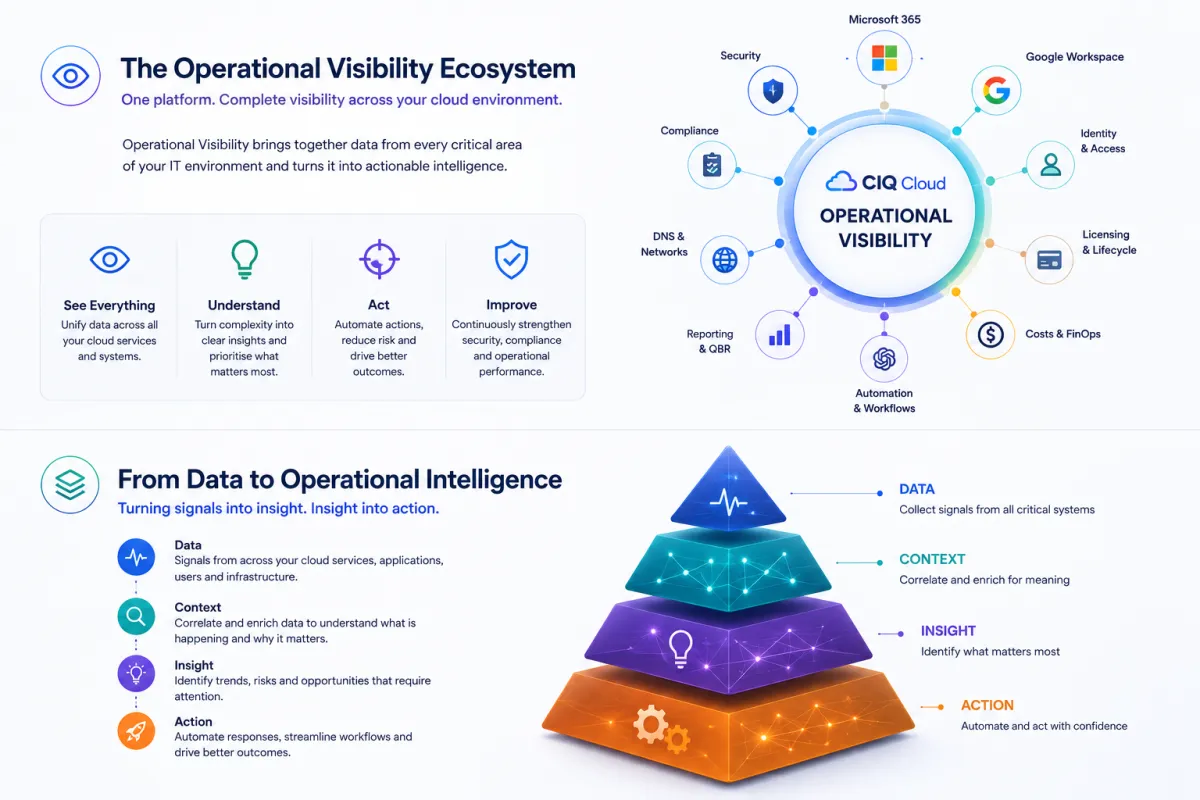
The Operational Visibility Ecosystem
Modern Operational Visibility spans multiple areas of IT operations.
Cloud Services
Understand the health, usage and configuration of critical cloud services including Microsoft 365, Google Workspace and other SaaS platforms.
Identify changes, service issues and operational risks without continually switching between multiple administration portals.
Security
Continuously assess security posture and identify areas requiring attention.
This can include security configuration, identity risks, privileged access, MFA adoption, suspicious activity and security posture changes.
Compliance
Maintain continuous visibility into the controls and configurations that support compliance frameworks and organisational policies.
Instead of treating compliance as a once-a-year exercise understand your Cyber Security status, so that Operational Visibility helps organisations understand their compliance position throughout the year.
Identity and Access
Monitor users, privileged roles, guest accounts and access controls.
Understand who has access to critical systems and identify lifecycle or governance issues that could create unnecessary risk.
Licensing and Costs
Understand how cloud services and licences are actually being used.
Identify unused or under-utilised licences, monitor spending trends and highlight opportunities to reduce unnecessary expenditure.
AI Platforms
AI introduces a new operational domain.
Organisations increasingly need visibility into AI usage, costs, projects, API keys, rate limits, model lifecycle and budget consumption.
An AI service can be technically healthy while creating significant operational, financial or governance risks.
DNS and Critical Infrastructure
DNS is fundamental to almost every modern organisation, yet it is frequently managed separately from other operational services.
Operational Visibility can help monitor DNS health, configuration, records, changes and other critical infrastructure dependencies.
User Experience
Technology ultimately exists to support users.
Understanding adoption, activity, collaboration and service usage helps organisations identify where technology is delivering value and where users may be experiencing problems.
Reporting and Business Reviews
Operational data becomes significantly more valuable when it can be translated into meaningful reporting.
For MSPs, this can support Quarterly Business Reviews and demonstrate ongoing value to customers.
For internal IT teams, it provides management with evidence of operational performance, risk reduction and technology utilisation.
Automation
Visibility should ultimately lead to action.
By connecting operational insights with alerts, workflows and remediation processes, organisations can reduce manual administration and respond more quickly when issues are identified.
Operational Visibility vs Observability
Operational Visibility and observability are complementary concepts, but they address different challenges.
Observability is primarily concerned with understanding the internal behaviour of software and infrastructure.
It uses telemetry such as:
Logs
Metrics
Traces
Observability helps developers and engineering teams understand why an application is slow, why a request failed or which component caused an outage.
Operational Visibility looks at the broader technology environment.
It considers:
Service health
Security
Compliance
Identity
Licensing
Costs
User activity
AI consumption
Cloud configuration
Operational risk
Observability might tell you why an API request failed.
Operational Visibility can tell you that an AI project is approaching its monthly budget, an API key has become inactive, a model is approaching deprecation or a project's usage pattern has changed significantly.
Both are valuable, they simply answer different questions.
Why Operational Visibility Matters
Reduce Operational Blind Spots
The more platforms an organisation adopts, the more fragmented operational information becomes.
Operational Visibility helps eliminate the gaps created when important information is spread across multiple portals, dashboards and reports.
Instead of relying on administrators to remember where to look, relevant information can be surfaced centrally.
Identify Problems Earlier
Many operational issues do not immediately generate outages.
A security configuration can gradually weaken.
Licence waste can increase month after month.
Guest accounts can accumulate.
AI spending can rise unexpectedly.
DNS configurations can change.
Operational Visibility helps identify these trends before they develop into larger security, financial or operational problems.
Improve Security Posture
Security is not a static state.
Configurations change.
Users change.
New applications are introduced.
Permissions evolve.
Operational Visibility provides continuous insight into security posture, helping IT teams identify changes and prioritise areas requiring attention.
Strengthen Compliance
Compliance should not depend solely on periodic audits.
By continuously monitoring relevant configurations, policies and operational controls, organisations can identify potential compliance gaps earlier and maintain a better understanding of their ongoing position.
Control Technology Costs
SaaS, cloud and AI services have made technology consumption increasingly dynamic.
Operational Visibility helps organisations understand what they are using, what they are paying for and where resources may be wasted.
This creates opportunities to optimise licences, identify inactive resources and manage emerging areas of expenditure such as AI.
Reduce Administrative Overhead
Without central visibility, IT teams spend significant amounts of time moving between vendor portals.
Entra ID
Google Workspace
DNS providers
Security tools
Licensing portals
Operational Visibility consolidates relevant information so administrators can spend less time searching for problems and more time solving them.
Operational Visibility for MSPs
For Managed Service Providers, the challenge is multiplied across every customer.
Each customer may have different licences, configurations, cloud platforms, security requirements and operational priorities.
Operational Visibility provides MSPs with a consistent way to understand the health of multiple customer environments.
Instead of manually reviewing individual customer portals, MSP teams can identify which customers require attention and why.
This can help MSPs:
Prioritise operational issues across customers
Identify security and compliance risks
Highlight licence optimisation opportunities
Improve user lifecycle management
Deliver consistent service reviews
Automate QBR reporting
Demonstrate ongoing value
Identify opportunities for additional services
The result is a shift from reactive support towards proactive service management.
Operational Visibility for Enterprise IT
Internal IT teams face a different challenge.
They may manage thousands of users and dozens or hundreds of cloud services, but operational responsibility is often distributed across separate teams.
Security has one set of tools.
Infrastructure has another.
Microsoft 365 administrators have their own portals.
Finance monitors cloud spending.
Compliance teams maintain separate reporting.
Operational Visibility creates a shared operational view.
It allows IT leaders and operational teams to understand the state of the environment without requiring every stakeholder to become an expert in every underlying platform.
This supports better decision-making across security, governance, cost optimisation, service management and technology strategy.
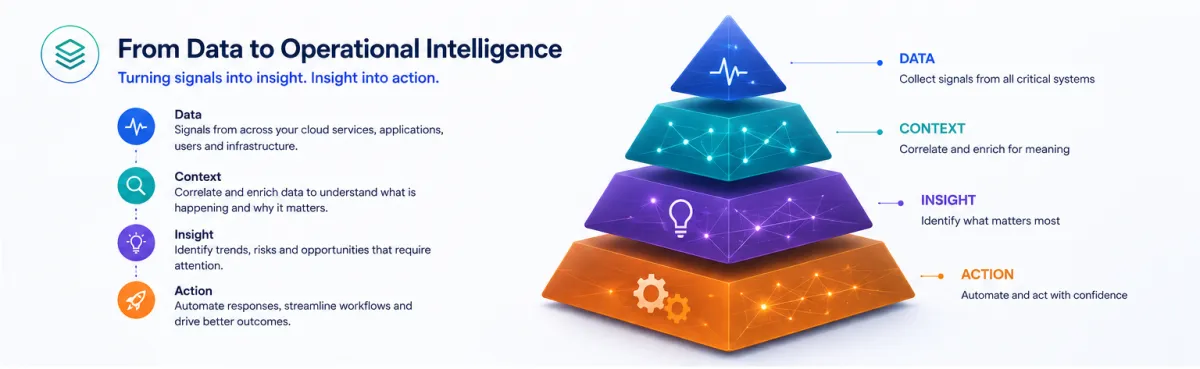
From Data to Operational Intelligence
The challenge facing modern IT teams is no longer a shortage of data. It is knowing what matters.
A typical organisation can generate millions of individual data points across its technology estate.
More dashboards do not necessarily solve the problem. More alerts can actually make it worse. Operational Visibility should reduce noise rather than increase it.
The objective is to transform data into context.
What changed?
Why does it matter?
Who is affected?
How important is it?
What should we do next?
This is where Operational Visibility evolves into Operational Intelligence.
Instead of simply presenting information, an Operational Visibility platform can help organisations correlate signals, identify trends and prioritise action.
See Everything. Understand What Matters. Act With Confidence.
We believe effective Operational Visibility can be summarised in three principles.
See Everything
Bring critical operational information together across cloud services, security, identity, compliance, licensing, AI, DNS and user activity. Reduce the blind spots created by fragmented platforms and disconnected administration portals.
Understand What Matters
Turn raw operational data into meaningful insight. Highlight changes, risks, trends and opportunities that require attention rather than overwhelming teams with unnecessary information.
Act With Confidence
Give IT teams the context they need to make better decisions. Prioritise the issues that matter most, automate repetitive processes and take action before small operational issues become major problems.
Operational Visibility with CIQ Cloud
CIQ Cloud is designed to provide a unified Operational Visibility layer across the modern cloud environment. Rather than replacing the specialist platforms organisations already use, CIQ Cloud brings together relevant operational information from across the technology ecosystem.
This includes visibility across areas such as:
Microsoft Entra ID
Microsoft Secure Score
Microsoft Teams
Exchange Online
SharePoint
OneDrive
Intune
Power BI
Google Workspace
DNS services
Cloud costs
Licensing
Security and compliance
User lifecycle
Network monitoring
PSA and service management integrations
By consolidating these operational signals, CIQ Cloud helps MSPs and IT teams build a clearer picture of their environment.
One platform.
One operational view.
A better understanding of what requires attention.
The Future of IT Operations Is Visibility
IT environments will continue to become more distributed.
Organisations will adopt more SaaS platforms.
AI consumption will increase.
Cloud spending will become more dynamic.
Security and compliance requirements will continue to evolve.
Adding another dashboard for every new technology is not a sustainable solution.
IT teams need a way to understand the bigger picture.
Operational Visibility provides that perspective.
It connects the signals generated across the technology estate and turns them into information that people can understand and act upon.
Observability helps you understand your applications.
Monitoring tells you when something has failed.
Operational Visibility helps you understand how your technology environment is operating as a whole.
And when you can see everything, understand what matters and act with confidence, IT operations become more proactive, efficient and valuable to the organisation.
Give your IT department Operational Visibility
Start your free 14 - day trial of CIQ® Cloud and see how effortless Operational Visibility can be.
No credit card required • Cancel anytime • Purpose-built for Office 365, Google Workspace and cloud-first environments

Innovation
Fresh, creative solutions.

Integrity
Honesty and transparency.

Excellence
Top-notch services.

FOLLOW US

COMPANY
CUSTOMER CARE
LEGAL
Copyright 2006 - 2026. Almaden, Inc . All Rights Reserved.