
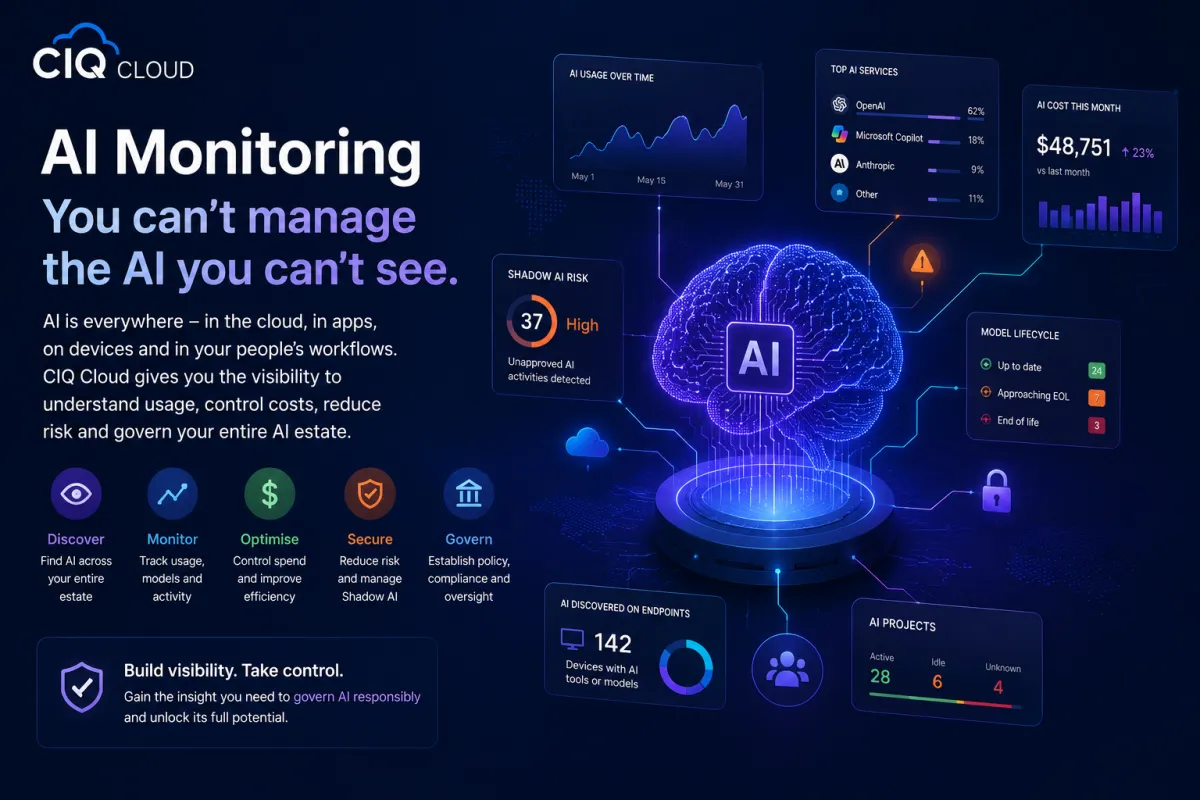
AI Monitoring
You Can't Manage the AI You Can't See
Artificial intelligence is rapidly becoming embedded across the modern technology estate.
Developers are building applications using generative AI APIs. Employees are using browser-based AI assistants. Business teams are adopting SaaS platforms with embedded AI capabilities. Technical users are experimenting with locally installed Large Language Models, while organisations are increasingly deploying AI agents and automated workflows.
Much of this adoption can happen without going through the traditional IT procurement, deployment and governance processes used for conventional software.
That creates a significant new visibility challenge.
For many organisations, the question is no longer whether AI is being used. It is whether anyone has a complete understanding of where it is being used, how it is being used, what it costs and what risks it may introduce.
AI Monitoring is the process of creating that visibility.
It enables organisations to understand the AI technologies becoming part of their environment, monitor the services they already know about and begin discovering AI activity that may otherwise remain invisible.
As AI adoption accelerates, this visibility is becoming an essential foundation for effective operations, security, cost management and governance.
The AI Estate Is Growing Faster Than Traditional IT Visibility
Most organisations already understand the concept of an IT estate.
It includes endpoints, servers, cloud services, SaaS applications, networks, identities and the other technologies required to operate the business.
AI is now creating a new layer across that estate.
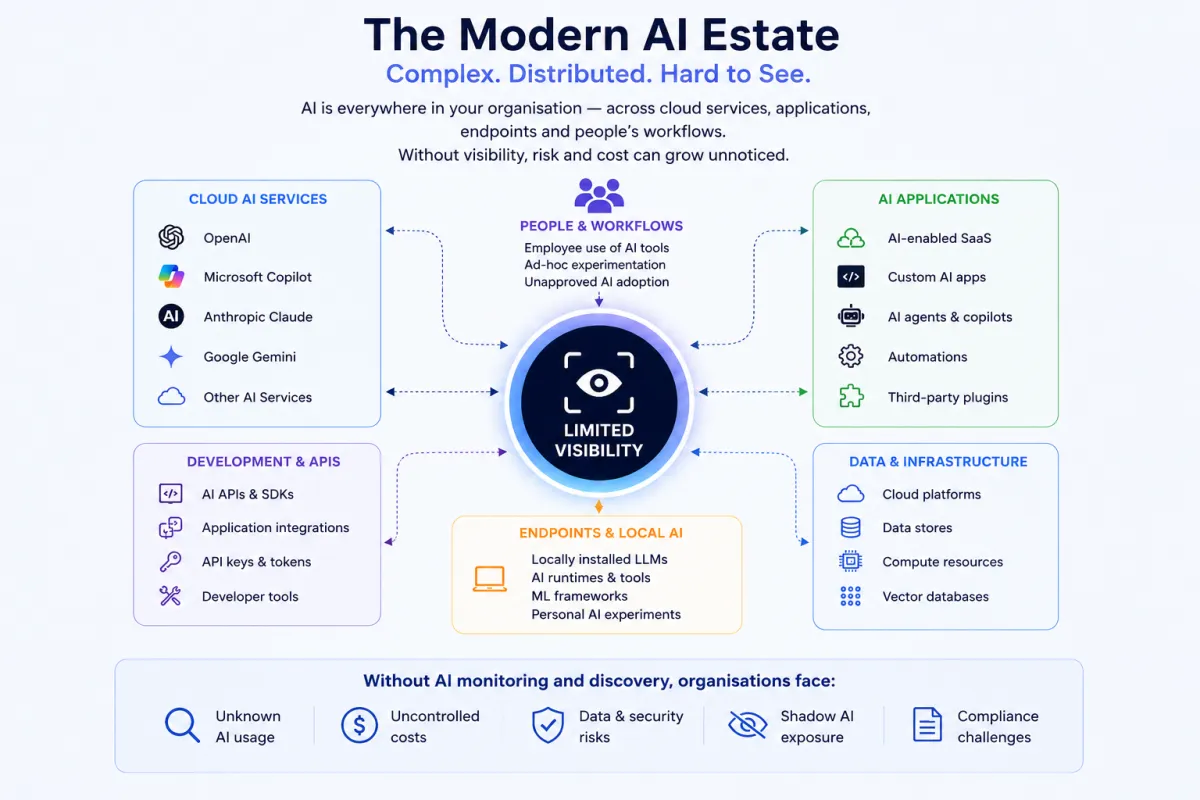
An organisation's AI Estate may include externally hosted AI platforms, API-driven applications, locally running models, AI-enabled SaaS products, development frameworks and autonomous agents.
Unlike traditional enterprise software, these technologies may not always be introduced through a central IT process.
A software development team can connect to an AI API using a credit card and an API key. A technically capable employee can download a local model and run it on a workstation. A SaaS vendor can introduce AI functionality into a product that the organisation already uses.
The result is that the AI Estate can evolve much faster than existing asset management and monitoring processes.
Without a dedicated approach to AI visibility, organisations can quickly reach a point where they know AI is being used but cannot confidently describe the full extent of that usage.
Why AI Monitoring Is Becoming Important
Traditional monitoring has focused largely on questions such as whether a service is available, whether infrastructure is healthy or whether an application is performing correctly.
AI introduces a different set of operational questions.
An organisation may need to understand whether AI usage is growing unexpectedly, whether expenditure is increasing, whether applications are dependent on ageing models or whether local AI tools are appearing on managed devices.
These issues do not necessarily create an immediate outage. Instead, they gradually create operational, financial and governance risk.
An AI service may continue working perfectly while becoming increasingly expensive. An application may remain operational while depending on a model that is approaching retirement. A local LLM may run successfully while remaining completely unknown to the organisation's security or governance teams.
AI Monitoring therefore extends traditional observability by helping organisations understand not only whether AI is working, but how AI is being adopted, consumed and managed.
The Challenge of Shadow AI
One of the most significant consequences of rapid AI adoption is the growth of Shadow AI.
Shadow AI describes the use of artificial intelligence technologies outside approved or centrally governed processes.
This might involve an employee using a public generative AI service to process business information, a developer connecting an application to an external AI API or a user installing a local Large Language Model on a company device.
The challenge is that these activities may be difficult to identify. Unlike traditional enterprise software, many AI tools require little or no formal deployment. Some operate entirely through a browser. Others can be installed as lightweight applications or downloaded as development tools.
The risks associated with Shadow AI vary depending on how the technology is used. Sensitive business information could be submitted to an external service. Intellectual property could leave the organisation. AI applications may process personal or regulated data without appropriate oversight. API credentials may be created without central management.
The starting point for addressing these risks is visibility. Organisations need ways to identify the AI services they already know about while gradually improving their ability to discover AI technologies appearing elsewhere in the environment.
AI Cost Can Grow Without Warning
AI also introduces a different economic model from traditional software licensing.
Many AI services are consumption based. Costs may depend on tokens, requests, compute resources or model usage. This means expenditure can change rapidly as applications scale.
A new application may initially cost very little during development but become significantly more expensive after launch. A workflow that runs hundreds of times per day may consume far more AI resources than expected. A software defect could repeatedly call an AI service and generate unnecessary expenditure.
When different departments or development teams operate independently, overall AI spending can become fragmented and difficult to understand. Effective AI Monitoring should therefore include financial visibility. Organisations need to understand how consumption changes over time, which projects are responsible for usage and whether expenditure is moving outside expected levels. Without this information, AI costs can become visible only when invoices arrive. By then, the organisation is reacting rather than managing.
Understanding How AI Is Being Used
Cost visibility is important, but consumption alone does not provide the complete picture, organisations also need context. A sudden increase in AI usage may be perfectly legitimate because a new application has launched. Alternatively, it may indicate an inefficient process, unexpected behaviour or a project that requires investigation.
Understanding AI usage therefore means connecting consumption to projects, applications and models. This helps IT and platform teams understand where demand is coming from and how different AI initiatives are evolving and whether you are suffering from AI Sprawl. Over time, this also provides valuable strategic insight. An organisation may discover that AI adoption is concentrated within a small number of development teams, or that one particular project accounts for most consumption. Another may identify rapid growth across multiple departments.
These insights help organisations make more informed decisions about investment, architecture and governance.
AI Models Introduce a New Lifecycle Risk
Traditional software applications already require organisations to manage versions, updates and end-of-life dates. AI models introduce a similar challenge, but the pace of change can be significantly faster. New models are released frequently. Older models may be superseded, deprecated or eventually removed. Applications that depend on these models can therefore inherit lifecycle risk.
A development team may build an important business process around a specific model and then move on to other priorities. Months later, that model may approach retirement without anyone maintaining a clear dependency record. When this happens, the organisation may need to migrate applications at short notice.
AI Monitoring can help reduce this risk by improving visibility into the models associated with AI projects and applications.
Understanding which models are being used, where they are used and how their lifecycle is evolving allows organisations to plan rather than react.
Local AI Makes Discovery More Difficult
Cloud AI platforms are only one part of the AI landscape. Modern laptops and workstations are increasingly capable of running sophisticated AI models directly. Tools such as local LLM runtimes make it possible for users to download models and execute them without sending requests to an external cloud service. From a privacy perspective, this can sometimes be beneficial. From an IT visibility perspective, however, it introduces a new challenge.
A local model may never appear in a SaaS management platform or cloud billing dashboard because all processing takes place on the endpoint. Organisations therefore need to consider AI discovery as part of their wider asset management strategy.
Software inventory, endpoint telemetry and other asset information can provide indicators that AI runtimes, model management tools or AI development frameworks are present. This does not provide perfect visibility, but it begins to establish a picture of where local AI may be appearing across the estate.
No Single Tool Can See Every Form of AI
One of the most important realities of AI Monitoring is that complete discovery is difficult. AI can exist in many forms.
A user may access a public AI service through a browser. A developer may use an API. A local LLM may operate on a workstation. Another model may run inside a Docker container or virtual machine. AI functionality may also be embedded within a SaaS platform without the user necessarily thinking of it as a separate AI application.
This means AI visibility must be built from multiple sources. Cloud AI APIs can provide detailed information about known services.
Endpoint inventory can identify some locally installed AI technologies. SaaS monitoring can provide visibility into cloud applications.
Identity, network and security data may provide additional context.
The goal should therefore not be to expect a single data source to discover everything. Instead, organisations should progressively build an AI visibility layer by combining the information available across their technology environment.
AI Monitoring Comes Before AI Governance
Many organisations are now developing formal AI governance policies. These policies may define which AI services are approved, what information employees can submit to AI systems, how models should be evaluated or how AI-generated outputs should be reviewed. Policies are important. But policies alone do not provide visibility.
An organisation may have a comprehensive AI governance policy while still having little idea whether employees or developers are following it. This is why AI Monitoring and AI Discovery are foundational to AI governance. Before an organisation can effectively govern its AI Estate, it needs to understand what exists.
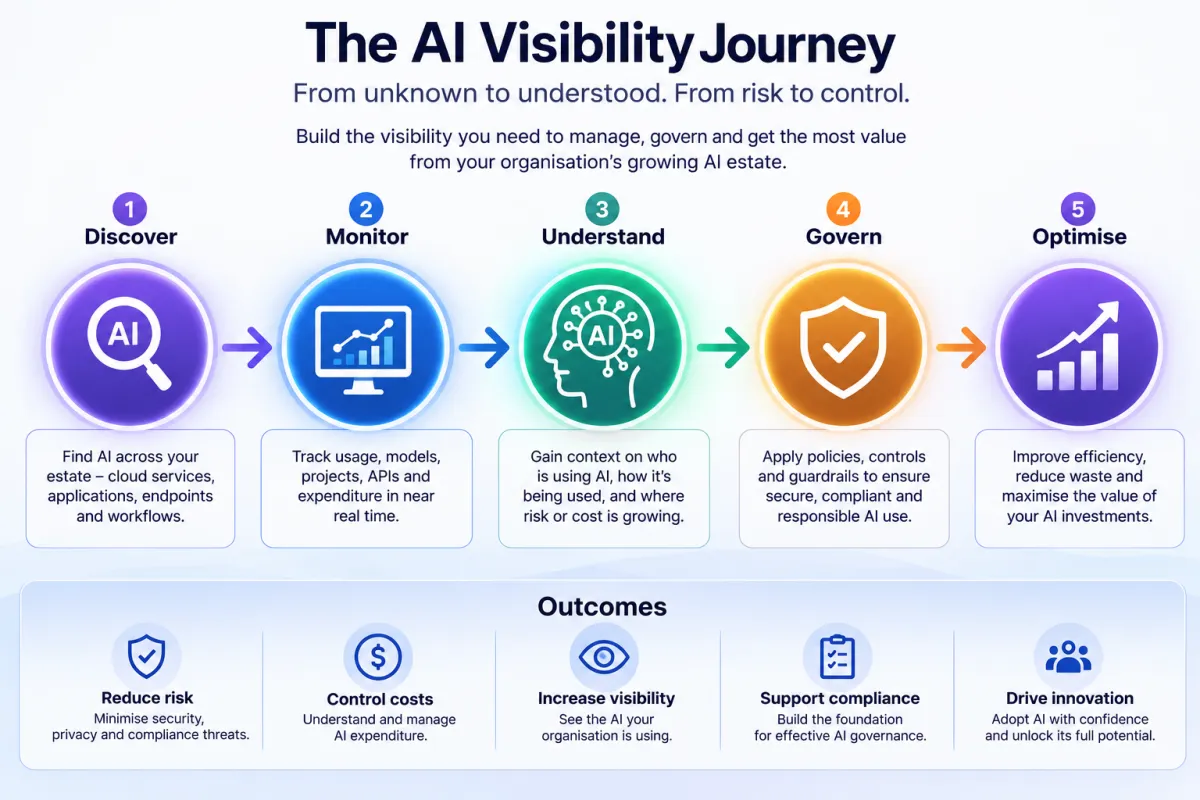
The natural progression is:
Discover → Monitor → Understand → Govern → Optimise
Discovery establishes what AI technologies are present.
Monitoring shows how known services are being used.
Understanding provides context around cost, risk and adoption.
Governance introduces appropriate policies and controls.
Optimisation helps organisations improve efficiency and maximise the value of their AI investments.
Without the first three stages, governance risks becoming largely theoretical.
AI Monitoring as Part of Operational Visibility
AI should not be viewed as a completely separate technology environment. AI applications depend on the same infrastructure, users and services as the rest of the organisation.
They rely on identities.
They run on endpoints.
They consume cloud services.
They access APIs.
They interact with business data.
They operate across networks.
For this reason, AI Monitoring is most valuable when it becomes part of a broader Operational Visibility strategy. An organisation should ultimately be able to understand AI alongside the rest of its technology estate.
For example, IT teams may want to see whether locally installed AI technologies are appearing on managed devices, whether AI projects are generating unusual expenditure or whether important applications depend on models approaching end-of-life. This wider context helps organisations move beyond simply knowing that AI exists. It allows them to understand the role AI is playing within the business.
The Benefits of Greater AI Visibility
For enterprise IT teams, improved AI visibility can support better decision-making across operations, security and finance.
Technology leaders gain a clearer understanding of how quickly AI adoption is growing and where investment is being directed. Security and governance teams gain a stronger foundation for identifying unapproved usage. Finance teams gain better insight into AI expenditure and consumption patterns.
For Managed Service Providers, AI Monitoring also creates an opportunity to expand the strategic value they provide to customers. As AI adoption grows, organisations will increasingly need guidance around cost, governance and technology risk.
An MSP that can help a customer understand its AI Estate can move beyond traditional infrastructure monitoring and become a more strategic partner in the organisation's AI adoption journey.
Start by Building Visibility
AI is likely to become one of the most significant additions to the enterprise technology estate in decades. The organisations that manage it most effectively will be those that understand how it is being adopted.
That starts with visibility.
Understand the AI services you already know about.
Monitor how they are being consumed.
Identify how much they cost.
Understand the models your applications depend upon.
Begin discovering AI technologies appearing elsewhere across the estate.
Then use that information to build stronger governance and make better decisions. AI Monitoring provides the foundation.
See How CIQ® Cloud Provides AI Discovery and Monitoring →
Give your IT department compliance and governance visibility
Start your free 14 - day trial of CIQ® Cloud and see how effortless Microsoft 365, Google Workspace and cloud monitoring can be.
No credit card required • Cancel anytime • Purpose-built for Office 365, Google Workspace and cloud-first environments

Innovation
Fresh, creative solutions.

Integrity
Honesty and transparency.

Excellence
Top-notch services.

FOLLOW US

COMPANY
CUSTOMER CARE
LEGAL
Copyright 2006 - 2026. Almaden, Inc . All Rights Reserved.