
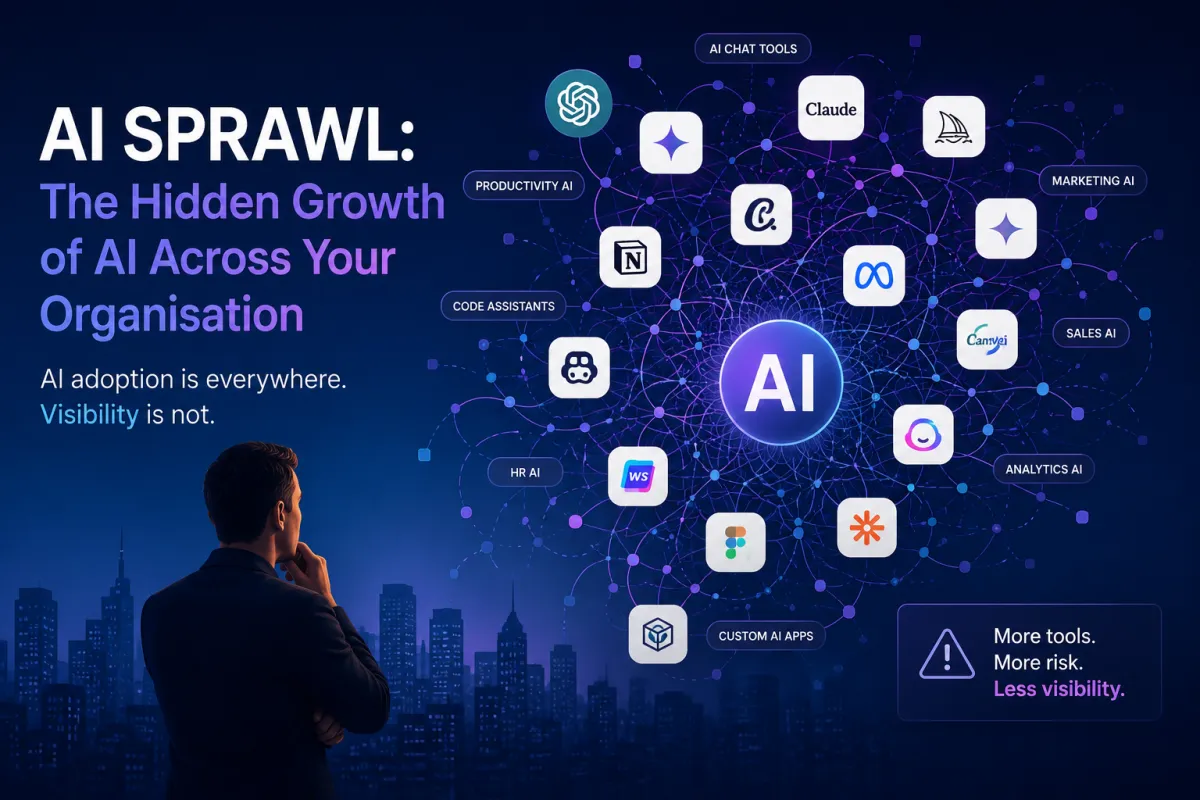
AI Sprawl: The Hidden Growth of AI Across Your Organisation
AI Sprawl: The Hidden Growth of AI Across Your Organisation
Artificial Intelligence has become one of the fastest adopted technologies in business history. Employees can now summarise documents, analyse spreadsheets, generate code, create presentations and automate repetitive work in seconds. Business units are deploying AI-powered SaaS platforms, developers are embedding large language models into applications, and departments are purchasing specialist AI tools without waiting for central IT approval.
This rapid innovation delivers significant productivity gains, but it also introduces a new operational challenge that many organisations are only beginning to recognise: AI Sprawl.
Unlike Shadow AI, which focuses on unauthorised or unmanaged AI usage, AI Sprawl describes the uncontrolled growth of AI technologies across an organisation. Even when every deployment has been approved individually, the combined AI estate can quickly become difficult to understand, manage and govern.
For many organisations, AI Sprawl develops gradually. One team adopts Microsoft Copilot. Another integrates OpenAI into an internal application. Marketing purchases an AI content platform. HR begins using AI recruitment software, while developers experiment with Claude, Gemini or locally hosted language models. None of these decisions are necessarily wrong, but collectively they create a technology estate that few organisations can accurately map.
The result is an environment where nobody can confidently answer seemingly simple questions.
Which AI services are we using?
Who owns them?
Which departments depend on them?
What data is being processed?
How much are they costing?
Are they still required?
Without clear visibility, AI becomes increasingly difficult to govern.
Why AI Sprawl Happens
Unlike traditional enterprise software, AI services are remarkably easy to adopt. Most require nothing more than a credit card or an existing Microsoft or Google subscription. APIs can be integrated within hours, and cloud-hosted AI platforms eliminate the need for infrastructure planning.
This low barrier to entry encourages experimentation. Initially this is positive. Organisations should encourage innovation and allow teams to discover where AI can deliver value. The challenge comes when experimentation becomes permanent.
Projects that begin as small proof-of-concepts often evolve into business-critical systems. API keys remain active long after projects finish. Multiple departments unknowingly purchase tools that provide similar functionality. Individual teams develop their own governance processes—or none at all. Over time, AI usage expands faster than operational oversight.
The Business Risks of AI Sprawl
AI Sprawl is rarely caused by poor decisions. Instead, it is usually the natural consequence of successful AI adoption.
However, without continuous visibility, several problems begin to emerge.
Security teams lose visibility into which AI platforms process corporate information. Compliance teams cannot easily determine whether regulated or sensitive data is being sent to approved services. Procurement discovers duplicate subscriptions and overlapping functionality. Finance struggles to forecast rapidly increasing AI expenditure.
At the same time, operational teams have little understanding of API usage, model selection, project ownership or inactive deployments that continue generating costs.
These issues compound as organisations scale their AI adoption.
An organisation may believe it operates five AI platforms when the real number is closer to fifty.
AI Sprawl Isn't Just About Applications
When people think about AI Sprawl, they often imagine a growing list of AI applications. In reality, the AI estate is much broader. Organisations increasingly need visibility into:
Public AI services employees access.
Enterprise AI platforms.
AI-powered SaaS applications.
Embedded AI features within existing business software.
OpenAI, Anthropic and other LLM API integrations.
API keys and service accounts.
Locally installed language models.
AI development projects.
Department-specific AI solutions.

Each component may be managed independently, making it difficult to understand the organisation's overall AI footprint. Without a complete picture, governance becomes reactive rather than proactive.
AI Sprawl vs Shadow AI
These two terms are often confused, but they describe different problems.
Shadow AI refers to AI usage that operates outside established governance processes. Employees may use unauthorised AI tools or external services without approval, potentially exposing corporate information or creating compliance risks.
AI Sprawl is broader.
It includes both authorised and unauthorised AI deployments. The issue is not whether AI has been approved, but whether the organisation still maintains visibility and control as the AI estate grows.
In many organisations, Shadow AI eventually becomes AI Sprawl.
Once an initially unofficial tool proves valuable, it is often adopted more widely. Without structured governance, it simply becomes another unmanaged part of an increasingly complex AI ecosystem.
Why Traditional Asset Management Isn't Enough
Most IT Asset Management solutions were designed to discover hardware, operating systems and installed software. Modern AI services often bypass these traditional discovery methods.
Cloud-hosted AI platforms may never install software locally. Developers can integrate APIs directly into applications. AI features increasingly appear within existing SaaS products without introducing new software installations.
Simply knowing what software is installed no longer provides a complete picture of organisational AI usage. Modern AI governance requires visibility across identities, cloud services, API usage, SaaS platforms, locally installed models and business applications.
Continuous Visibility Is the Key
The most effective organisations do not attempt to stop AI adoption. Instead, they focus on maintaining continuous operational visibility.
This means understanding where AI exists today, identifying how that picture changes over time and ensuring governance evolves alongside innovation.
Rather than conducting occasional audits, organisations benefit from continuously discovering new AI services, monitoring usage patterns, understanding business context, applying governance policies and optimising both cost and risk.
This is why effective AI governance is not a one-off project but an ongoing operational lifecycle.
Discover → Monitor → Understand → Govern → Optimise

Importantly, this is not a linear process. As new AI services are introduced, acquired or retired, the lifecycle repeats continuously, ensuring organisations always have an accurate view of their AI estate.
Detecting AI Sprawl Before It Becomes a Problem
Early detection is significantly easier than trying to untangle years of uncontrolled growth.
Useful indicators include rapidly increasing numbers of AI subscriptions, duplicated capabilities across departments, unknown API keys, inactive projects that continue consuming budget, unmanaged AI-enabled SaaS applications and locally installed language models appearing across endpoints.
When viewed individually, these may seem minor.
Viewed collectively, they reveal how quickly AI Sprawl can develop.
The earlier organisations gain visibility, the easier governance becomes.
How CIQ® Cloud Helps
CIQ® Cloud has been designed around the principle of Operational Visibility.
Rather than focusing on a single AI platform, CIQ Cloud helps organisations understand their wider AI estate. By combining AI discovery, continuous monitoring and governance reporting, organisations can build an accurate inventory of AI technologies across their environment while identifying unmanaged growth before it becomes a security, compliance or financial issue.
This enables IT and security teams to answer critical operational questions with confidence: what AI technologies exist, who owns them, how they are being used and whether they align with organisational policies.
As AI adoption accelerates, maintaining this continuous visibility becomes increasingly important.
Looking Ahead
AI adoption will only continue to grow. New services appear every week, existing business applications continue embedding AI capabilities and organisations increasingly build their own AI-powered solutions.
The organisations that succeed will not be those that restrict AI. They will be the organisations that understand it.
Continuous operational visibility allows businesses to embrace innovation while maintaining governance, controlling costs and reducing risk. The first step is simply knowing what AI exists across your organisation today.
The next is ensuring you never lose sight of it again.