
Operational Visibility vs Observability: What's the Difference?
Operational Visibility vs Observability: Why Modern IT Needs More Than Logs and Metrics
Operational Visibility vs Observability: What's the Difference?
For years, observability has been one of the biggest buzzwords in IT operations. Every monitoring vendor promises observability, dashboards and telemetry that help engineers understand what is happening inside their applications.
Observability is incredibly valuable—but it was never designed to answer every operational question an organisation faces.
Modern IT teams don't just run applications.
They manage Microsoft 365, Google Workspace, SaaS platforms, AI services, cloud infrastructure, user identities, licensing, security posture, DNS, compliance requirements and increasingly complex automation platforms.
Knowing that an application responded in 200 milliseconds doesn't tell you whether:
Microsoft 365 security has deteriorated
An OpenAI project is exceeding its budget
A DNS zone is about to expire
Guest accounts are growing unchecked
A user has impossible travel activity
Hundreds of expensive licences are unused
A Cyber Essentials control has failed
These are operational problems—not application problems.
This is where Operational Visibility becomes essential.
What is Observability?
Observability originated from software engineering.
It focuses on understanding the internal behaviour of systems through three primary data sources:
Logs
Metrics
Traces
Engineers use observability platforms to investigate:
Performance bottlenecks
API latency
Memory utilisation
Database response times
Application errors
Infrastructure failures
When an application slows down or crashes, observability helps explain why.
It answers questions such as:
Why did this request fail?
Which service caused the delay?
What happened before the outage?
For development teams, observability is indispensable.
But for many IT departments, these aren't the questions keeping them awake at night.
The Missing Layer
Most organisations today rely on dozens, or even hundreds, of cloud services.
Each has its own portal.
Its own reports.
Its own alerts.
Its own licensing model.
Its own security recommendations.
IT administrators often spend more time switching between dashboards than actually solving problems.
The challenge isn't a lack of data.
It's the lack of a single operational view across everything that matters. This harks back to the old concept of a Manager of Managers, or MoM, sometimes called a Single Pane of Glass, or SPoG.
What is Operational Visibility?
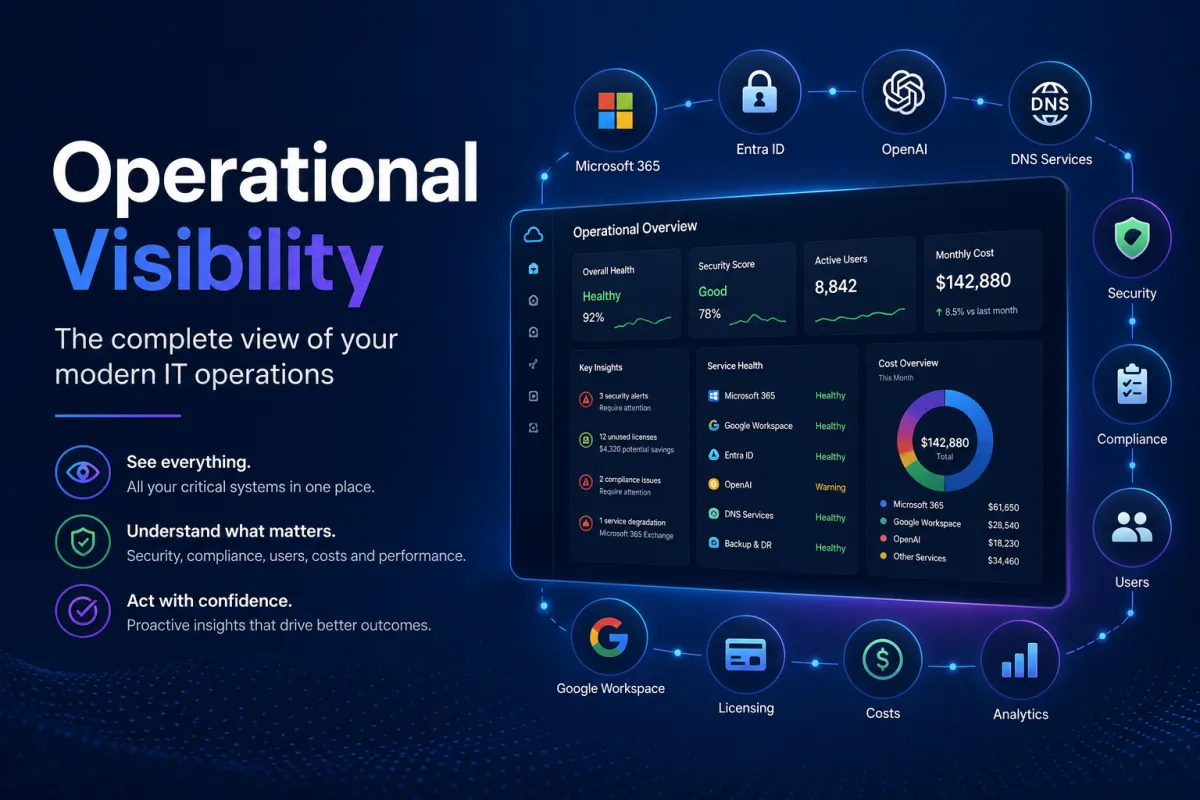
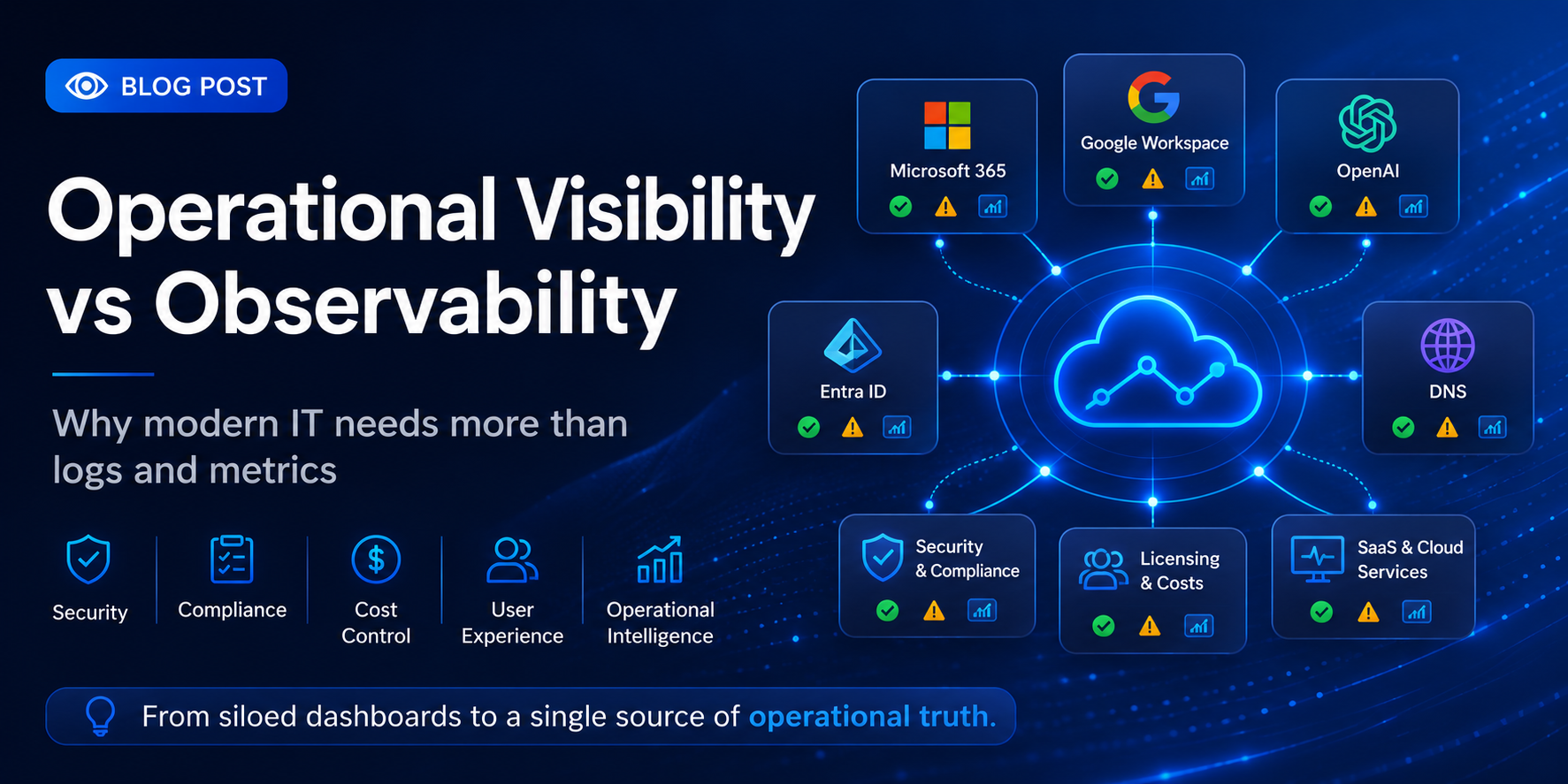
Operational Visibility brings together operational information from every critical platform into one place.
Instead of concentrating on how software behaves internally, Operational Visibility focuses on how your technology estate performs as a business service.
It combines and correlates information from areas such as:
Microsoft 365
Google Workspace
OpenAI
DNS services
SaaS applications
Security platforms
Licensing
Compliance frameworks
Identity management
Automation systems
Rather than analysing millions of log entries, Operational Visibility answers questions like:
Is my organisation secure?
Are we compliant?
Are licences being wasted?
Which users need attention?
Which services are unhealthy?
Where are costs increasing?
Which systems require action today?
This is information that IT managers, MSPs and business leaders can immediately act upon.
Observability vs Operational Visibility
Custom HTML/CSS/JavaScript
Neither replaces the other, they solve different problems.
Many organisations already have excellent observability tools.
What they often lack is a way to understand the operational health of the services that employees rely on every day.
Why Operational Visibility Matters
Security
Instead of manually checking multiple portals, IT teams can immediately identify:
Security score changes
MFA weaknesses
Privileged account risks
Suspicious sign-ins
Identity anomalies
Configuration drift
Compliance
Frameworks such as Cyber Essentials, CIS Controls and ISO 27001 require continuous monitoring.
Operational Visibility provides ongoing evidence instead of relying solely on annual assessments.
Cost Optimisation
Cloud spending continues to grow.
Operational Visibility highlights:
Unused licences
Under-utilised subscriptions
AI usage trends
Departmental costs
Budget overruns
Wasted resources
User Experience
Operations teams can quickly identify:
Collaboration issues
Service degradation
Mail delivery problems
Storage consumption
Application adoption
User activity trends
Operational Efficiency
Instead of monitoring dozens of vendor portals, administrators receive a consolidated operational view showing:
What changed
What needs attention
What is healthy
What is becoming a risk
Operational Visibility for AI
Artificial Intelligence introduces an entirely new operational challenge.
Monitoring AI isn't just about whether an API responds successfully.
Organisations also need visibility into:
Project costs
Token consumption
Model versions
Deprecated models
API key usage
Error rates
Rate limits
Budget alerts
Project activity
Security
Shadow AI usage
This is a perfect example of Operational Visibility extending beyond traditional observability.
An AI application may be technically healthy while operationally creating significant cost or governance risks.
The Future of IT Operations
As organisations adopt more SaaS platforms and AI services, operational complexity continues to increase.
Every vendor provides another dashboard.
Another portal.
Another report.
Another alert.
The challenge is no longer collecting information.
The challenge is turning that information into operational intelligence.
Operational Visibility provides that missing layer by bringing together security, compliance, licensing, cloud services, AI, identity, collaboration and operational health into a single, actionable view. It is also a key input into the Quarterly Business Review with your customers.
How CIQ Cloud Delivers Operational Visibility
CIQ® Cloud is built around the principle of Operational Visibility.
Rather than focusing solely on application telemetry, CIQ Cloud continuously monitors the operational health of your cloud environment across Microsoft 365, Google Workspace, AI platforms such as OpenAI, DNS services and other critical business systems.
By combining security, compliance, licensing, operational health, cost management and automation into a single platform, CIQ Cloud helps IT teams identify issues earlier, reduce operational overhead and make informed decisions based on a complete view of their cloud estate.
Because the platform consolidates data from multiple services into one operational dashboard, organisations spend less time navigating vendor portals and more time improving security, controlling costs and delivering reliable services.
Conclusion
Observability transformed the way software teams understand applications.
Operational Visibility transforms the way IT teams manage modern organisations.
The two are complementary, not competing.
Observability explains how your applications are performing.
Operational Visibility shows how your business technology is performing.
As cloud services, SaaS applications and AI continue to grow, organisations that embrace Operational Visibility will be better equipped to reduce risk, optimise costs, strengthen security and make faster, more informed operational decisions.