
QBR for MSPs: How to Deliver More Valuable Customer Reviews
Why QBRs Matter: Turning Customer Data into Better Business Conversations
For many Managed Service Providers, the Quarterly Business Review (QBR) has become an expected part of the customer relationship. Every few months, the MSP and customer sit down together, review what has happened, discuss outstanding issues and look at what needs to happen next.
Done well, a QBR can be one of the most valuable conversations an MSP has with a customer.
Unfortunately, many QBRs have gradually become reporting exercises.
The MSP spends hours gathering information from different systems, assembling charts and screenshots, documenting ticket statistics and service availability, and building a presentation. The customer is then presented with a retrospective view of the previous quarter.
There is nothing inherently wrong with this information. The problem is that reporting what happened is not the same as helping a customer decide what to do next.
A more valuable QBR starts with operational visibility.
It brings together information from across the customer's technology environment, identifies the things that actually matter, provides context around them and turns the QBR from a service report into a business conversation.
That is the approach behind CIQ Cloud.
What Should a QBR Actually Achieve?
A good QBR should create value for both sides of the relationship.
For the customer, it should provide reassurance that their technology environment is being actively managed rather than simply supported when something goes wrong. It should help them understand where they have unnecessary costs, emerging risks, governance issues and opportunities to improve.
For the MSP, the QBR provides something equally important: an opportunity to demonstrate value.
Much of an MSP's best work is invisible.
If systems remain available, users are productive, security configurations are maintained and problems are prevented before they become incidents, the customer may see very little happening.
Ironically, a well-managed environment can sometimes make an MSP appear less valuable because there are fewer visible problems.
The QBR is an opportunity to change that perception.
Instead of simply saying "everything worked this quarter", the MSP can demonstrate what was discovered, monitored, improved and prevented, and where further action could benefit the customer's business.
The Problem with the Traditional QBR
Traditional QBR preparation is often surprisingly manual.
Information may need to be collected from Microsoft 365, Entra ID, Intune, security tools, OpenAI, ticketing systems, monitoring platforms, licensing portals and spreadsheets.
Someone then has to decide what is important, turn that information into something presentable and repeat the exercise for every customer.
For an MSP with dozens or hundreds of customers, that quickly becomes expensive.
It also creates another problem.
Because preparing detailed QBRs takes time, the process naturally gravitates towards information that is easiest to collect.
Ticket volumes. Response times. Endpoint counts. Service availability. Backup success rates.
These are useful operational metrics, but they don't necessarily answer the questions the customer cares about:
Are we secure?
Are we compliant?
Are we wasting money?
What has changed?
What should we be worried about?
What should we do next?
That difference is important.
A QBR shouldn't simply prove that the MSP has been busy. It should help the customer make better decisions.
A Different Kind of QBR
Imagine an MSP preparing for a quarterly review with a 150-user customer.
Under the traditional approach, an account manager starts gathering information several days before the meeting.
They pull ticket statistics from the PSA. They obtain licensing information from Microsoft 365. Someone checks Secure Score. Another engineer looks at Intune and Entra ID. A few charts are copied into PowerPoint.
Eventually, a 25-page presentation appears.
The meeting goes well.
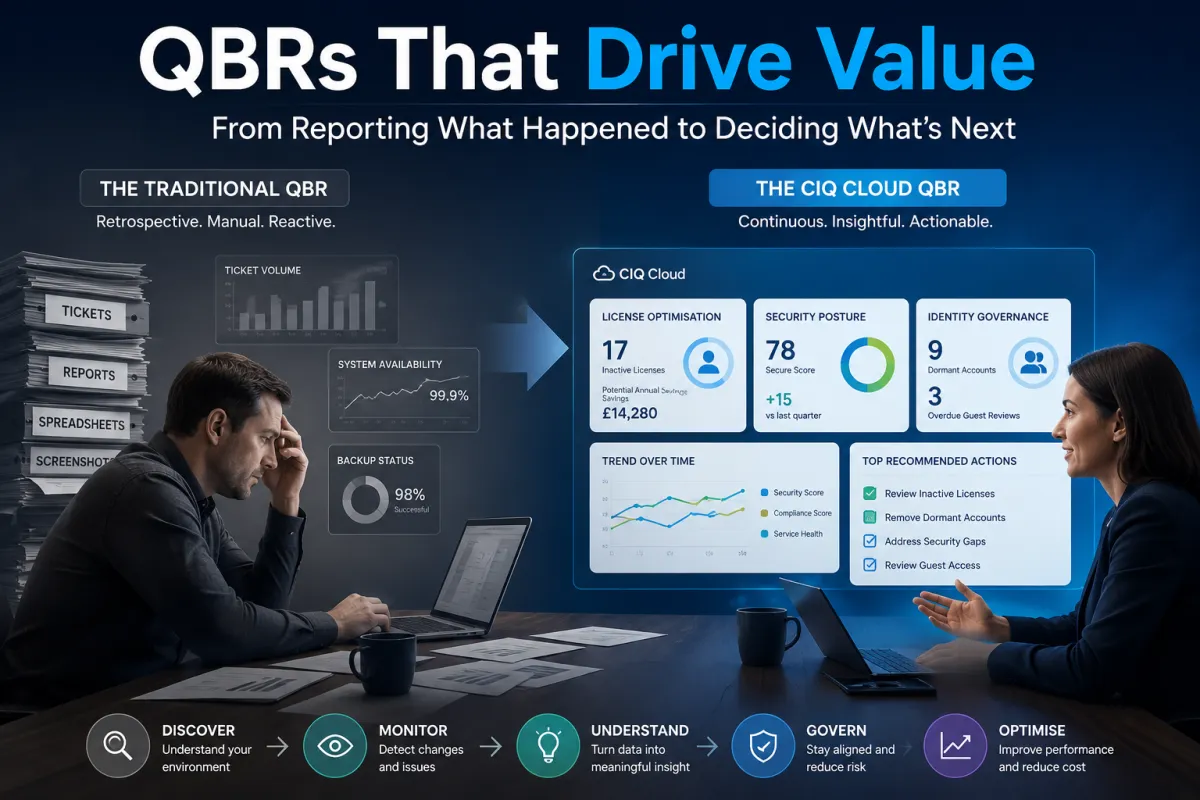
Ticket volumes are down. Availability was 99.9%. Backups completed successfully.
Everyone leaves reasonably happy.
Now imagine the same meeting using CIQ Cloud.
Rather than beginning with the question "What can we put in the QBR?", the MSP already has continuous visibility of the customer's environment.
During the quarter, CIQ Cloud has been collecting and analysing information across the services being monitored.
The MSP discovers that the customer has 17 Microsoft 365 licences assigned to accounts that have shown little or no meaningful activity. Several accounts belong to employees who have left but haven't completed the expected lifecycle process.
A number of guest accounts haven't been reviewed recently.
One security configuration has drifted away from the customer's expected baseline.
The customer's Microsoft security posture has improved during the quarter, but several recommended actions remain outstanding.
The MSP can now walk into the QBR with a very different story.
From "Here Are Your Statistics" to "Here Is What We Found"
Instead of spending the first twenty minutes reviewing ticket graphs, the conversation begins with outcomes.
"Over the last quarter your overall environment has remained stable, but we've identified several areas where we think we can improve security and reduce unnecessary cost."
The MSP shows the customer the inactive licences. Enterprise IT also benefit from from an Enterprise IT QBR.
Some are immediately explained. Others aren't.
The customer discovers that several licences can be removed at the next renewal, potentially avoiding unnecessary expenditure for another year.
The discussion then moves to the dormant accounts.
These aren't simply licensing issues. They represent governance and potentially security concerns. The MSP recommends tightening the joiner, mover and leaver process.
Next comes security posture.
The customer can see what has improved since the previous review, what has changed and which actions would deliver the greatest benefit.
The QBR has now moved well beyond reporting. It has created an actionable programme for the next quarter.
The Difference Is Continuous Visibility
The biggest difference between these two approaches isn't the presentation.
It is what happens during the other 89 days of the quarter.
Traditional QBRs can become snapshots. Information is gathered shortly before the meeting and represents the environment at that particular moment.
CIQ Cloud is designed around continuous operational visibility.
That aligns with the broader CIQ Cloud lifecycle:
Discover → Monitor → Understand → Govern → Optimise

And importantly, this isn't a process that happens once every quarter.
It is continuous.
Discovery identifies what exists across the environment. Monitoring identifies changes and emerging issues. Understanding adds context so that raw data becomes useful information. Governance helps ensure the environment remains aligned with organisational requirements. Optimisation identifies opportunities to reduce cost, improve efficiency and make better use of technology.
The QBR becomes the point where that continuous process is translated into a strategic conversation with the customer.
QBRs Should Show Change, Not Just State
There is another important difference.
Knowing that a customer has a particular security score today is useful.
Knowing that it was lower three months ago, understanding why it improved and identifying what remains outstanding is considerably more valuable.
The same applies to licensing.
Knowing that a customer has 150 licences tells us very little.
Knowing that they have 150 licences, 17 appear underutilised, six users have changed roles and the annual Microsoft renewal is approaching creates an opportunity for action.
This is where historical and contextual information makes the QBR more useful.
The conversation changes from:
"This is what your environment looks like."
to:
"This is how your environment is changing, why it matters and what we recommend doing next."
The Value to the Customer
For customers, this approach provides much greater transparency.
They don't need to understand every Microsoft 365 configuration, security recommendation or licensing metric. What they need is confidence that someone is continuously looking at the environment and can explain what matters.
The QBR becomes an opportunity to understand risk, cost and priorities in business terms.
It can highlight potential savings before a licence renewal.
It can identify security or governance gaps before they become incidents.
It can identify things such as AI Sprawl, which the customer won't be aware of.
It can demonstrate progress against security and compliance objectives.
And it creates a documented set of priorities for the next quarter.
Instead of receiving another technology report, the customer receives evidence that their MSP understands their environment and is actively helping to improve it.
The Value to the MSP
The benefits for the MSP are just as significant.
Automating the collection and analysis of operational information can dramatically reduce the effort required to prepare meaningful QBRs, making it practical to provide them consistently across a much larger customer base.
But the bigger advantage is commercial.
When an MSP can demonstrate risks, opportunities and improvements using evidence from the customer's own environment, conversations about additional services become much more natural.
A recommendation to improve identity security isn't simply an upsell when the QBR has demonstrated the underlying problem.
A licensing review isn't an abstract consulting service when the customer can see licences that appear to be unused.
A governance project isn't based on fear when the customer can see dormant accounts, configuration drift or other areas requiring attention.
The MSP moves from selling additional services to recommending actions based on evidence.
That is a fundamentally different customer conversation.
Making the QBR Part of the Service
Perhaps the biggest opportunity is to stop thinking about the QBR as something that happens every three months.
The meeting happens quarterly.
The QBR process shouldn't.
Operational visibility should exist continuously, with the quarterly meeting providing a natural point to step back and look at trends, progress, risks and priorities.
CIQ Cloud helps MSPs build that continuous picture across the customer's cloud and technology environment, turning operational data into information that can support better conversations.
The result is a QBR that takes less effort to prepare while potentially delivering considerably more value.
For the customer, it provides greater visibility, stronger governance and clearer evidence that their MSP is actively improving their environment.
For the MSP, it demonstrates value, strengthens the customer relationship and creates evidence-based opportunities for optimisation and additional services.
And that is ultimately what a QBR should be. Not a quarterly presentation about what happened. A conversation about what should happen next.