
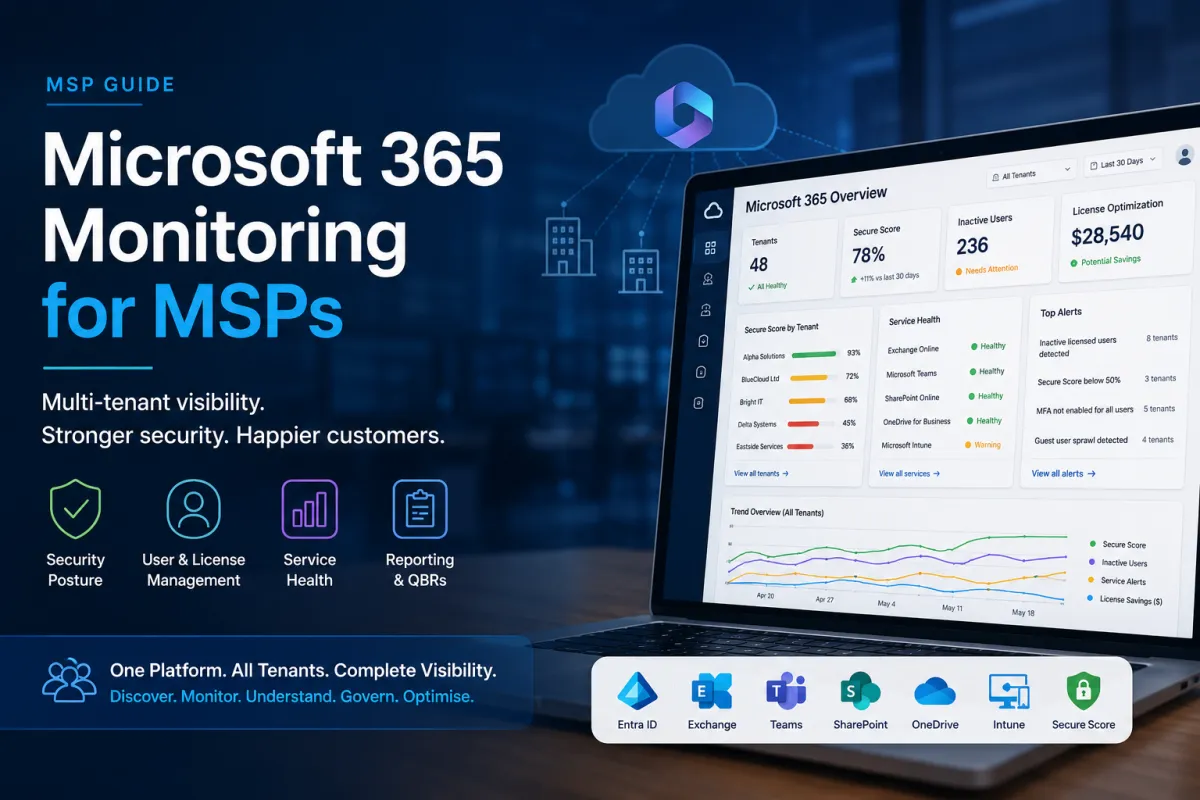
Microsoft 365 Monitoring for MSPs: Why the Admin Center Isn’t Enough
Microsoft 365 Monitoring for MSPs: Why the Admin Center Isn’t Enough
Managed Service Providers are responsible for an increasing proportion of their customers' cloud infrastructure. For many MSPs, Microsoft 365 has become one of the most important parts of that responsibility.
Email, Teams, SharePoint, OneDrive, Entra ID, Intune and Microsoft 365 licensing can all sit within the same customer environment. Add security configuration, Microsoft Secure Score and user lifecycle management, and there is a considerable amount for an MSP to monitor.
The problem isn't necessarily a lack of information. Microsoft provides extensive administration and reporting capabilities. The challenge for an MSP is that much of this information is organised around individual Microsoft 365 tenants.
An MSP managing 10, 50 or 100 customers has a very different requirement.
Instead of asking, "What's happening in this Microsoft 365 tenant?", the MSP needs to ask:
"What's happening across all of the Microsoft 365 environments we manage?"
That difference is what makes Microsoft 365 monitoring for MSPs a distinct operational challenge.
Microsoft 365 Wasn't Designed Around the MSP Dashboard
Microsoft provides powerful administration tools for managing Microsoft 365, but an MSP typically operates across multiple customer environments.
An engineer investigating an individual customer can use the relevant Microsoft administration portals to examine users, licensing, security or services.
The challenge comes when the MSP wants to identify issues proactively.
Which customers have deteriorating security configurations?
Which tenants have large numbers of inactive licensed users?
Where are MFA or identity controls inconsistent?
Which customers have licences approaching renewal that could potentially be optimised?
Which environments require attention today?
Finding those answers by opening customers individually doesn't scale particularly well. The MSP needs an additional layer of operational visibility across Microsoft 365.
From Tenant Administration to Multi-Tenant Visibility
This is where Microsoft 365 monitoring starts to become particularly valuable for an MSP.
Rather than replacing Microsoft's administration tools, a monitoring platform can provide a consolidated view across the customer estate.
The objective isn't necessarily to put every piece of Microsoft 365 information onto one enormous dashboard. That can simply replace one form of information overload with another.
Instead, the objective should be to identify exceptions, changes and opportunities that require action.
An MSP might discover, for example, that three customers have experienced a reduction in their Microsoft Secure Score, another has a growing number of inactive accounts, and two have significant quantities of potentially unused Microsoft 365 licences.
The MSP can then investigate those customers rather than manually checking every environment. It is also important information which can be included as part of the Quarterly Business Review with their customers.
This moves Microsoft 365 management from a largely reactive process towards a proactive operational model.

What Should MSPs Monitor in Microsoft 365?
Microsoft 365 monitoring is considerably broader than service availability.
Knowing whether Exchange Online or Microsoft Teams is operational is important, but a service being available doesn't necessarily mean that the customer environment is healthy, secure or cost-effective.
An MSP should ideally have visibility across several dimensions.
Security posture can include Secure Score, identity configuration, MFA adoption, privileged accounts and other security controls. User and licence monitoring can identify inactive accounts, underutilised licences and opportunities to optimise Microsoft 365 expenditure.
Teams, OneDrive, SharePoint and Exchange data can help MSPs understand how services are actually being used. Intune and Entra ID provide another important layer of device and identity information. The result is a much broader picture of Microsoft 365 health than simple uptime monitoring.
Microsoft 365 Monitoring Should Support a Continuous Lifecycle
At CIQ Cloud, we view operational visibility as a continuous process:
Discover → Monitor → Understand → Govern → Optimise → Discover…

For an MSP, this is particularly important because customer environments are constantly changing.
New users arrive. Employees leave. Licences are assigned. Applications are introduced. Security settings change. Devices appear and disappear. Microsoft releases new capabilities and recommendations.
Discovery therefore isn't something that happens once when a customer is onboarded.
The MSP continually discovers what exists and what has changed, monitors its condition and usage, understands what those changes mean, applies appropriate governance and then looks for opportunities to optimise the environment. Once optimisation takes place, the process begins again. This turns Microsoft 365 monitoring into an ongoing operational discipline rather than a periodic audit.
Security Monitoring Across Multiple Customers
Security is one of the strongest arguments for continuous Microsoft 365 monitoring.
A configuration that was considered acceptable six months ago may no longer reflect current Microsoft recommendations or the customer's own security policies.
Equally, security posture can deteriorate because of relatively small operational changes.
A new administrator account might be created. MFA coverage could change. A security control might be disabled during troubleshooting and never re-enabled.
Looking across multiple tenants helps an MSP identify these changes much more quickly. Secure Score should let you compare tenants so you can see where you can improve from known Proven Wins - with CIQ Cloud it does.

Instead of waiting for a customer to ask whether their Microsoft 365 environment is secure, the MSP can proactively identify areas that require attention.
This can also support services built around Microsoft Secure Score, Cyber Essentials readiness and wider security governance.
Finding Microsoft 365 Licence Savings
Monitoring can also create a direct commercial benefit for customers.
Microsoft 365 licences represent a significant recurring expense, but organisations frequently accumulate licences that are no longer being used effectively.
Users leave organisations, roles change and temporary accounts become permanent fixtures.
A point-in-time licence review can uncover some of these issues, but continuous monitoring provides a better picture because usage can be considered over time.
For MSPs, licence optimisation is especially valuable ahead of Microsoft agreement renewals.
Identifying inactive or underutilised licences several months before renewal gives the customer time to validate the findings and make informed decisions about what they actually need for the next contract period.
The MSP moves from simply supplying licences to actively helping customers optimise their Microsoft investment.
Turning Monitoring Data into Better QBRs
There is another benefit that is sometimes overlooked: customer communication.
Many MSP Quarterly Business Reviews concentrate heavily on tickets.
How many tickets were opened? How quickly were they resolved? What were the major incidents?
Those metrics are useful, but they primarily demonstrate how well the MSP reacted to problems.
Operational visibility can tell a much stronger story.
An MSP can demonstrate improvements in security posture, licence optimisation opportunities, changes in Microsoft 365 adoption, identity governance and other measurable improvements.
A QBR can then say:
"During the last quarter we identified 14 inactive Microsoft 365 licences, improved your Secure Score by 11%, identified three identity risks and resolved two configuration issues before they affected users."
That is a much clearer demonstration of ongoing value than simply reporting ticket volumes.
From Microsoft 365 Monitoring to Wider Cloud Visibility
Microsoft 365 is also unlikely to be the only cloud platform an MSP manages.
Customers increasingly use combinations of Microsoft 365, Google Workspace, AWS, SaaS applications, AI services, DNS providers and other cloud platforms.
This creates another problem.
An MSP can solve Microsoft 365 visibility and still end up with a collection of separate monitoring portals.
The longer-term objective should therefore be broader operational visibility.
Microsoft 365 becomes one important data source within a wider view of the customer's technology environment.
This allows the MSP to consolidate information from multiple vendors while maintaining the specialist monitoring required for individual services.
Microsoft 365 Monitoring as an MSP Service
There is also an opportunity for MSPs to think differently about how monitoring is packaged commercially.
Rather than treating Microsoft 365 monitoring purely as an internal tool, the visibility it provides can become part of the managed service itself.
A basic service might provide continuous monitoring and alerting.
A more comprehensive service could include security posture reviews, licence optimisation, governance reporting and regular QBR analysis.
Higher-value packages could extend this into broader cloud operational visibility covering Microsoft 365 alongside other SaaS, cloud, AI and infrastructure services.
The technology therefore supports both operational efficiency and service differentiation.
How CIQ Cloud Helps MSPs Monitor Microsoft 365
CIQ® Cloud provides a multi-tenant operational visibility platform designed to help MSPs monitor customer cloud environments from a consolidated interface.
Instead of engineers repeatedly moving between individual administration portals, CIQ Cloud brings monitoring and analysis together across multiple customers.
Microsoft 365 capabilities can include visibility across areas such as licensing, Teams, OneDrive, Exchange Online, SharePoint, Entra ID, Intune, Power BI and Microsoft Secure Score.
More importantly, Microsoft 365 doesn't have to exist in isolation.
CIQ Cloud can combine Microsoft data with information from other cloud, SaaS, security, DNS, network and AI platforms to provide a broader view of the customer's technology estate.
The objective is simple:
Give MSPs the visibility to identify what needs attention before the customer has to ask.
Building a More Proactive Microsoft 365 Managed Service
Microsoft already provides excellent tools for administering individual Microsoft 365 environments.
The MSP challenge is different.
MSPs need to understand what is happening across many customer environments, identify exceptions quickly, demonstrate improvements and continuously find opportunities to improve security, governance and cost efficiency.
That requires moving beyond individual tenant administration towards multi-tenant operational visibility.
For MSPs looking to build more proactive Microsoft 365 services, monitoring isn't simply about detecting outages.
It's about continuously discovering, monitoring, understanding, governing and optimising the Microsoft 365 environments their customers depend upon.